A truck canopy door should let you reach the equipment you use most often without unloading the rest of the bed. For a work truck, that may mean accessing tool cases from the side. For an overlanding setup, it may mean reaching cooking equipment while keeping the rear opening available for larger loads.
Choose the access layout around three measurements: the clear opening, the space needed to open the panel and the route between the opening and the stored item. Then compare the hinges, gas struts, locks and replacement-parts support. This guide focuses on those decisions. For roof height, construction and the wider vehicle-fitment checklist, start with our high-rise truck cap buyer’s guide.
Choose Side Access Around Your Loading Routine
Start by listing the items you retrieve during a normal working day or camping stop. Mark which belong near the tailgate and which need access near the front of the bed. A full-length side opening helps only when shelves, cases and mounting brackets leave those items within reach.
For example, a service vehicle could place frequently used hand tools behind one side opening and reserve the rear route for larger equipment. A camping arrangement could put kitchen equipment beside a side door while longer items load through the back. These are layout ideas to test with your own cargo.
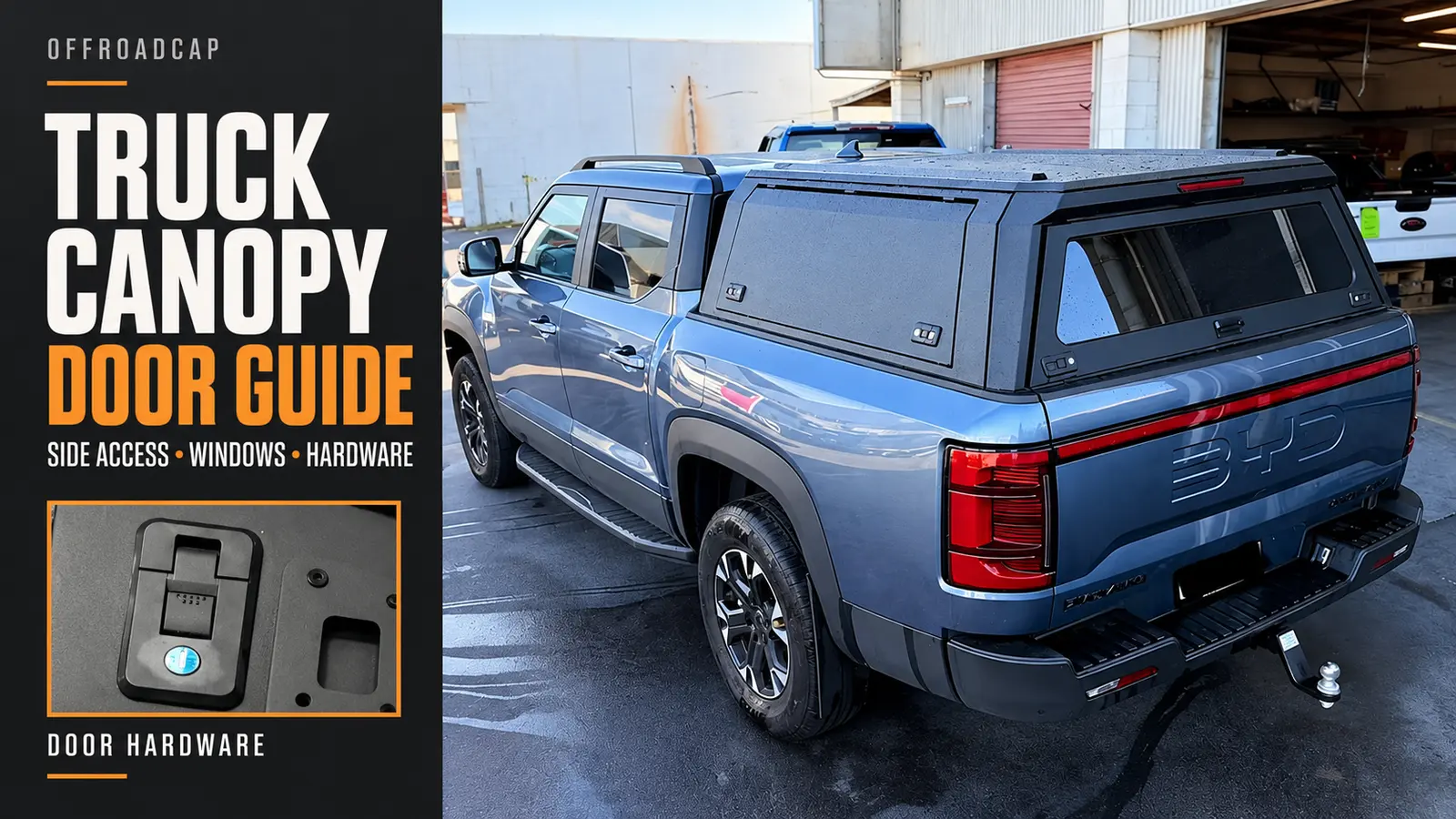
When comparing a truck canopy with door access, identify whether the quotation covers rear access only or also includes opening side panels. OFFROADCAP’s Ford Ranger 2023+ OC10115 listing describes lockable side and rear access panels. It establishes a product example, but does not publish a clear side-opening dimension or opening angle. Request the drawing for the quoted configuration before designing storage around it.
Solid Side Doors, Lift-Up Windows or Sliding Windows?
The terms side door and side window can describe different assemblies. Some glazed panels lift to expose a cargo opening. Other windows slide within a fixed frame. Compare the actual operation rather than assuming every truck canopy with doors offers the same access.
| Arrangement | Main purpose | What to check |
|---|---|---|
| Solid lift-up side door | Access to tools or equipment with the contents concealed when closed | Clear opening, panel support, locks and approved accessory attachments |
| Glazed lift-up side panel | Cargo access with a view through the closed panel | Actual opening size, glazing specification, latch position and replacement assembly |
| Sliding side window | An adjustable opening for airflow or limited access | How much of the frame opens, screen arrangement and cleaning access |
| Fixed side window | Visibility through a closed side panel | Glazing specification and whether another opening provides the required cargo access |
When comparing truck canopy windows, separate the glass dimensions from the usable opening. A large glazed area can sit in a fixed frame, while a smaller lift-up assembly may provide the access your equipment needs.
A truck cap with side windows may suit users who want visibility, an opening for airflow or both. Confirm which function the selected window provides. A solid door conceals cargo, but its material alone does not establish a theft-resistance rating. Compare the complete frame, hinges and locking arrangement.
List the required configuration for the left and right sides separately. This is particularly useful when a storage layout needs a solid access panel on one side and an opening window on the other. Availability remains specific to the canopy series and vehicle application.
Measure the Clear Opening, Not the Outer Door
Ask for the narrowest usable width and height with the door in its intended open position. Frames, seals, latch hardware and gas struts can occupy space around the aperture. Measure your cargo with handles, hinges, wheels and protective cases included.
For an initial check of a rectangular item passing straight through a rectangular opening in the stated orientation:
Total width clearance = clear opening width − item width.
Total height clearance = clear opening height − item height.
The following figures are assumed for illustration. They are not OFFROADCAP product dimensions or a recommended minimum clearance.
| Measurement | Assumed dimension | Result |
|---|---|---|
| Clear side opening | 1,050 mm wide × 420 mm high | Measure at the narrowest usable points |
| Tool case in the chosen orientation | 600 mm wide × 380 mm high | 450 mm total width clearance and 40 mm total height clearance |
| The same case with an upright handle | 600 mm wide × 440 mm high | 20 mm taller than the opening in that orientation |
The first case passes the two-dimensional size check, but still needs room for the operator’s hands, its depth and the loading movement. The 40 mm figure is the total height difference, not clearance on each edge. If the handle increases the height to 440 mm, that straight loading route fails.
A different orientation may work, but test the complete movement with a case or a simple full-size mock-up. Check the route past shelves, dividers and wheel arches and into the final secured position. Opening area alone cannot show whether a particular object fits.
For a high rise truck cap with door access, confirm the aperture separately from roof height. Extra interior headroom does not automatically increase the side opening. Our high-rise versus cab-high comparison explains how to check the cargo route alongside roof clearance.
Check Door Movement and the Space Beside the Truck
A lift-up panel needs clearance throughout its movement, as well as space in its final open position. Ask for the opening angle, the furthest outward projection and the height of the lowest exposed edge when open. Include handles and fitted accessories in that measurement.
Check the places where the truck will actually be used: a workshop bay, a campsite beside another vehicle or a parking space near a wall. Allow for the person standing at the opening and moving equipment through it. Test from a suitable standing position using the largest frequently retrieved item.
Roof racks, awning brackets and external storage can also interfere with the movement. Review the assembled layout rather than checking each accessory independently. Use our canopy roof rack guide when planning equipment above the opening.
For fleet vehicles, document which side users normally approach and whether that access remains practical at the intended stopping locations. Select the side-door arrangement from the working routine and available space.
Match Gas Struts to the Complete Door Assembly
Gas struts assist opening and support the panel according to the designed geometry. Their force rating is only part of the specification. Door mass, mounting positions, stroke, end fittings and operating conditions also matter.
Camloc’s gas-strut installation guidance explains that temperature changes affect opening and closing effort. The practical implication for buyers is to request operation checks under the temperatures expected in their market, instead of relying on one demonstration in the workshop.
Stabilus’s service guidance advises avoiding bending and transverse loads and keeping the piston rod free of paint and contamination. It also makes application-specific drawings and specifications the basis of gas-spring selection.
When specifying truck canopy door hardware, request the gas-strut part number, rated force in newtons, extended and compressed lengths, stroke, end fittings and approved installation orientation. Keep that information with the canopy model and door identification.
Adding a hanging panel, tools or another accessory to a moving door changes the mass and its distribution. Obtain approval for the loaded assembly, including brackets and hinges. A door that stays open when empty may behave differently after equipment is attached. Select replacement struts using the approved specification rather than choosing a higher force simply to compensate.
Truck Canopy Door Locks: Check Operation and Included Hardware
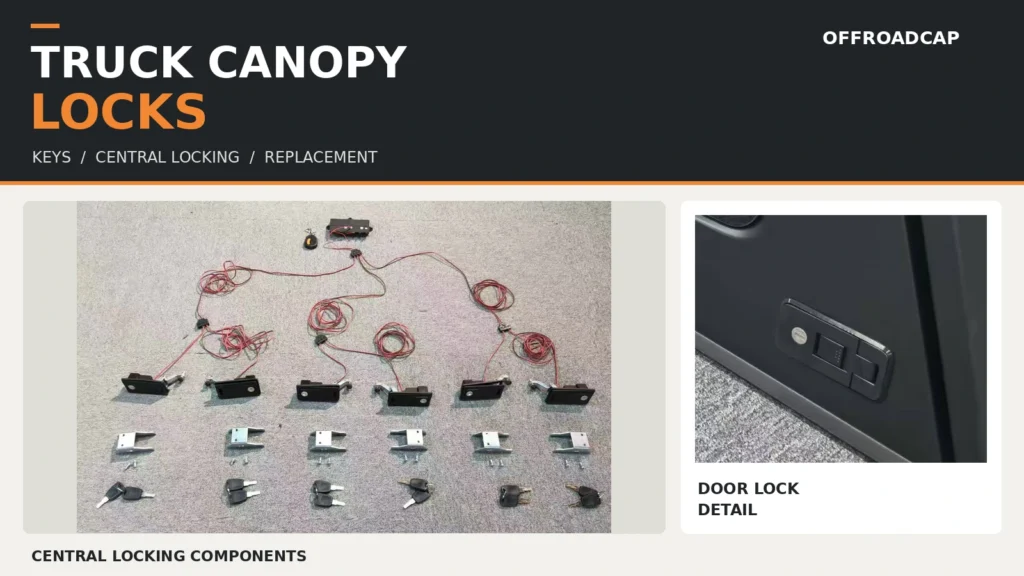
A specification for truck canopy door locks should identify how the latch engages, how many locking points are present and which parts can be replaced. Check that the door closes smoothly and that the locks operate without forcing the panel.
Keyed-alike mechanical locks and powered central locking are separate features. Specify which doors need to share a key and, when powered locking is requested, which openings are controlled and what manual access remains available.
During the sample inspection, operate each door several times, check the latch engagement and inspect the seal seating around corners. Repeat the checks after vehicle installation, since the final mounting arrangement is part of the complete assembly.
A truck canopy door seal needs to match the frame and intended contact surface. Inspect seating and corner joints, then use the selected model’s weather-protection check. Our truck canopy seal and leak-check guide covers door gaskets, windows and bed interfaces in more detail. A lock check and a water-ingress check answer different questions.
For a closer look at key groups, central-locking packages and replacement dimensions, read our truck canopy lock selection and replacement guide.
Ask for Door Durability Evidence With the Test Conditions
Turn the intended use into an estimated number of opening cycles. Define one cycle as opening and closing the same door once. The following calculation assumes one complete cycle for each retrieval, rather than leaving the door open for several tasks:
12 cycles per working day × 250 working days per year × 5 years = 15,000 cycles.
Those are planning assumptions, not measured customer usage or an OFFROADCAP service-life claim. Replace them with the expected routine for your fleet or market. Use the result to discuss a validation target, inspection criteria and replacement-parts planning with the supplier.
For a published component example, Camloc states a permitted maximum gas-spring force loss of 10% after 50,000 cycles, under ideal fitting conditions at room temperature and a maximum rate of three cycles per minute. It also identifies temperature, vibration and other application factors that can affect real-world life.
This example shows why the test conditions and acceptance criteria belong beside the cycle count. It is Camloc’s component statement. It does not establish that an OFFROADCAP door uses that component, has passed that test or will last a particular number of years.
For the complete canopy door, request a report identifying the panel, hinges, gas struts, latches, seals and any attached equipment. Check the cycle count, operating temperature, test setup and before-and-after observations. Useful results include continued latch engagement, panel alignment, seal contact and opening support. A gas-strut test alone leaves the rest of the assembly unverified.
Truck Canopy Door Replacement: Identify the Assembly First
A truck canopy door replacement should match the original opening and hardware arrangement. Similar outside dimensions do not confirm that hinge locations, seal profiles, latch positions or glazing interfaces will align.
Before ordering, send the supplier:
- The canopy series, model, serial number or order reference.
- Truck make, model, year, cab type, bed length and market.
- Which door is affected: left side, right side or rear.
- Photographs of the full assembly, hinge, latch, seal and any identification labels.
- The fault and the fitted accessories, including anything attached to the moving panel.
Ask whether the supplied item is a complete assembly or an individual panel, and whether hardware, seals and fitting instructions are included. Where service requires removing a supported door or glass assembly, use the supplier’s procedure and suitable handling arrangements.
For distributor orders, agree on part numbers for replacement locks, gas struts, hinges and seals before placing the bulk order. This creates a clear service route when a single component needs attention.
Keep Factory Door Choices and Optional Accessories Separate
The door layout belongs in the canopy configuration. Storage equipment and other attachments need their own compatibility checks. Keeping the two lists separate makes a quotation easier to understand and helps dealers identify what is included.
| Factory configuration | Optional equipment to check separately |
|---|---|
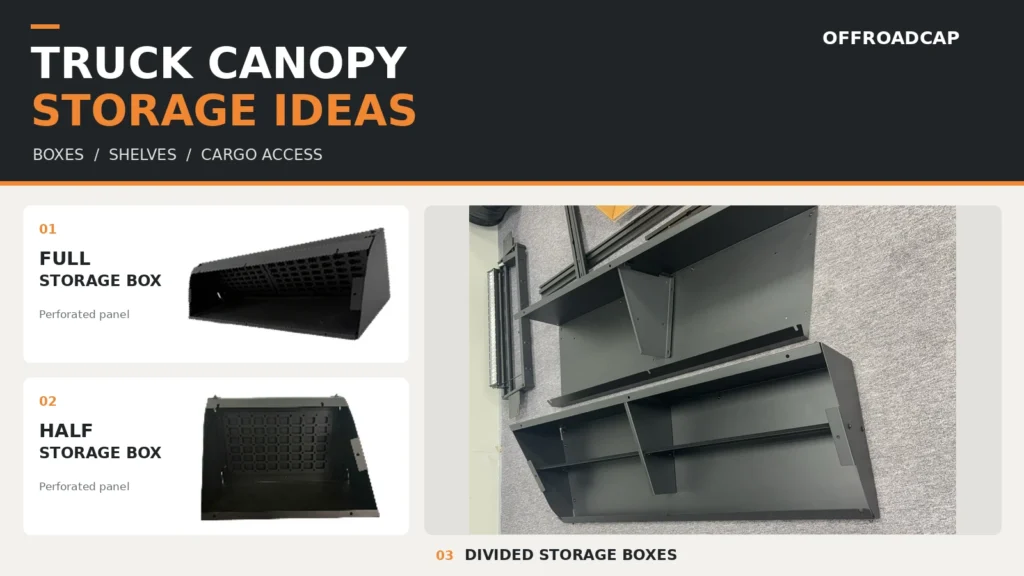
| Left and right door or window type, clear openings and opening movement | Storage boxes, shelves and dividers behind those openings |
| Hinges, gas struts, latches, locks, glazing and seals | Hanging panels or tools attached to a moving door, where approved |
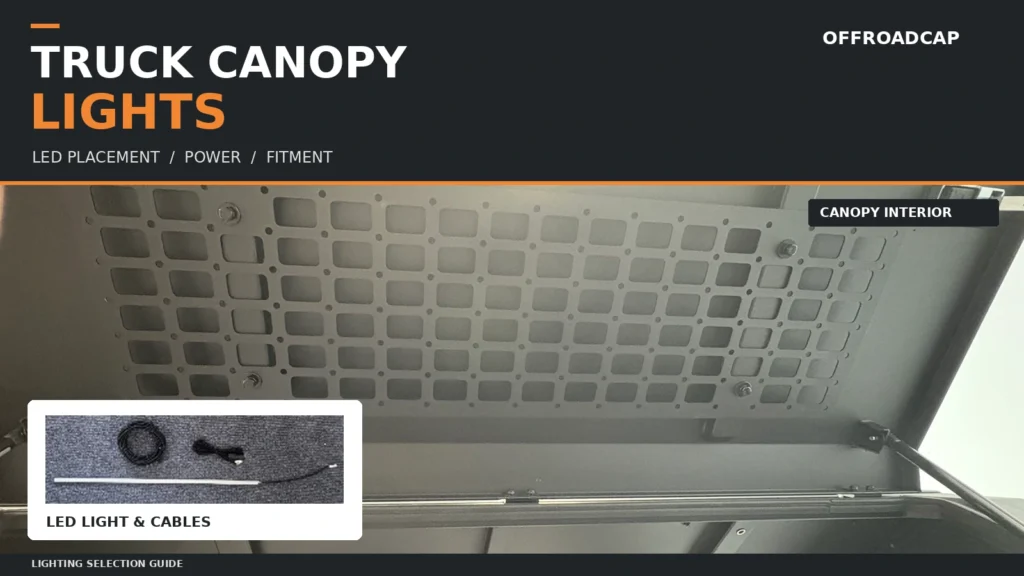
| Mechanical locking or specified powered-locking package | Additional lighting, switches and wiring requirements |
| Vehicle-specific fitment and finished configured weight | Roof racks, awnings and mounts that could affect door clearance |
Review pickup storage box options alongside the access drawing. Confirm installed dimensions, mounting requirements and the path used to remove the contents. Shipping carton measurements do not establish the installed storage envelope.
For the final fitment, follow our truck canopy installation guide together with the selected model’s fitting instructions. Record the approved door configuration and accessories at handover.
Frequently Asked Questions
Are full-length side doors always the best choice?
They can improve access to equipment near the front of the bed. Compare the clear opening, reach distance and storage layout with the items you use. A large door offers limited benefit if shelves or cargo block the route.
Can I choose different doors or windows on each side?
Ask which combinations are available for the selected canopy series and vehicle. Specify the left and right sides separately and request the corresponding drawing and component list.
Do truck canopy door locks include central locking?
Confirm that in the quotation. Mechanical locks can share a key without providing powered central locking. Specify which doors need powered operation and confirm the manual-access arrangement.
Does a high-rise roof give me a larger side door?
Confirm the opening dimensions directly. Roof height describes the enclosure profile, while the usable side aperture depends on the panel, frame and hardware.
Can I fit stronger gas struts after adding tools to the door?
Have the supplier assess the loaded door, mounting geometry, hinges and closing effort first. Obtain an approved strut and attachment specification for that assembly.
Does a 50,000-cycle gas-strut statement prove canopy-door life?
It describes the named component under its stated conditions. Complete-door durability also involves hinges, latches, seals, mounts and the fitted panel. Request evidence for the assembled configuration.
What should I provide when ordering a replacement door?
Provide canopy identification, vehicle details, the affected side and photographs of the assembly and hardware. Confirm whether the replacement includes the panel, hinges, locks, seals and fitting instructions.
Request a Door Layout for Your Vehicle and Cargo
Start with the OFFROADCAP pickup canopy range, then send the truck’s make, model, year, cab type and bed length. Include the market, canopy series, left and right access requirements, cargo dimensions and intended order quantity.
Add the planned storage arrangement, any equipment attached to moving panels and the space available beside the truck. Send OFFROADCAP your door and access requirements to discuss a vehicle-specific configuration and the fitment information needed for your project.