
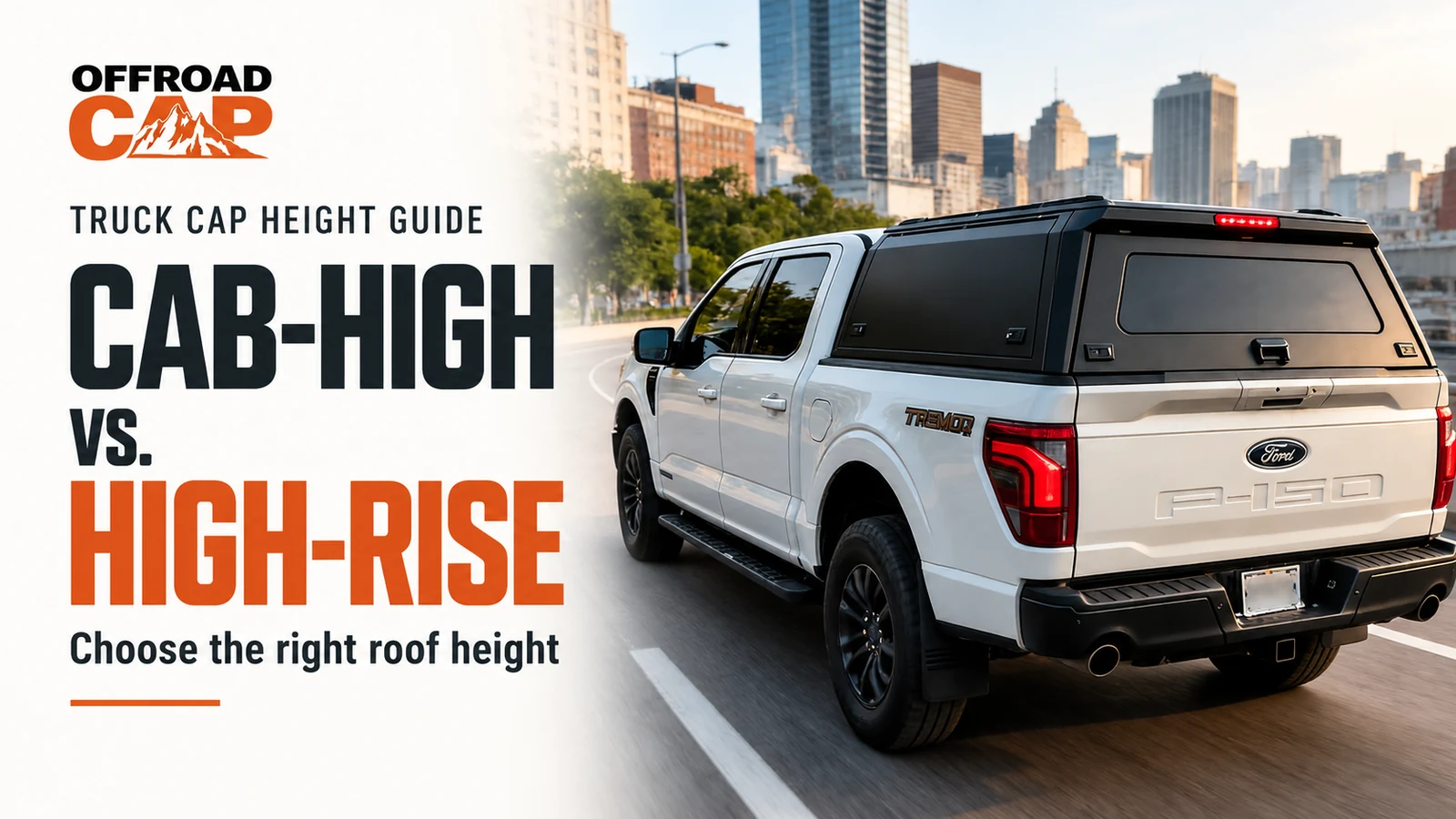
A cab high truck cap keeps the canopy roof approximately level with the pickup cab. A high-rise cap extends higher, creating additional space above the truck bed. The right choice depends on what you carry, how you load it and where the completed vehicle needs to fit.
If your equipment fits comfortably under a cab-high roof, extra height may offer little practical benefit. If a tall tool case or camping platform needs more clearance, a higher roof can solve a specific space problem. This guide compares the two profiles and shows which dimensions to check before ordering.
For the wider buying checklist covering construction, doors, sealing and mounting, read our high rise truck cap buyer’s guide. Here, the focus is choosing the roof height.
What Is a Cab High Truck Cap?
A cab-high truck cap follows the general height of the pickup’s cab roof. It encloses the bed while keeping a relatively low exterior profile. The term describes the roof’s position; it does not specify a particular material, door arrangement or internal height.
Cab-high caps can suit everyday luggage, organized work equipment and camping gear that already fit within the enclosure. A cab-high camper shell can also accommodate a sleeping setup when the platform, mattress and desired headroom fit the available space.
Do not assume two cab-high models have identical interior clearance. Bed depth, roof shape, frames and interior accessories all affect the space you can actually use.
How Do High-Rise and Mid-Rise Roofs Differ?
A high-rise truck cap has a taller roof profile than a cab-high design. That additional height can accommodate upright cargo or provide more room above a sleeping platform. It is useful when the extra space addresses a measured requirement.
A mid rise truck cap offers an intermediate profile. Some designs have a raised or sloping rear section, so the extra headroom may vary along the bed. For a buyer considering a high rise camper shell, a mid-rise option is worth comparing when only part of the load needs additional clearance.
The labels do not tell you how many inches or millimeters you will gain on a specific truck. Request a side-elevation drawing and internal dimensions for each candidate. Compare measurements taken from the same reference points.
Cab-High vs. High-Rise Truck Caps at a Glance
| Decision factor | Cab-high profile | High-rise profile |
|---|---|---|
| Roof position | Approximately follows the cab roofline. | Extends above the cab roofline. |
| Interior clearance | Check whether cargo and storage fit the available height. | Offers additional height, subject to the exact roof and frame geometry. |
| Garage access | May be easier to accommodate when it keeps the finished vehicle lower. | Requires checking the taller completed vehicle against entry restrictions. |
| Camping setup | Can work with a sufficiently low platform and mattress. | Can provide more room above a platform if the interior dimensions confirm it. |
| Cargo access | Depends on door openings and storage layout. | Still depends on door openings; a higher roof does not automatically enlarge them. |
| Roof accessories | Include racks and equipment in the total vehicle height. | Check both accessory clearance and the specified load limits. |
Height alone does not establish weight, price, roof-load capacity or fuel consumption. Compare the complete vehicle-specific configurations rather than treating the roof label as a performance rating.
Measure the Cargo and the Loading Route
Start with the tallest item that genuinely needs to travel upright. Measure its complete packed size, including handles, wheels, lids and any protective case. Record the width and depth as well as the height.
Then check three parts of the enclosure:
- The door opening: can the item pass through the clear opening without hitting a seal, latch or frame?
- The loading route: can it move from the opening to its storage position without being blocked by shelves, wheel arches or other equipment?
- The final position: is there sufficient clearance below the roof frame where the item will be secured?
A tall truck cap can have enough internal height while its rear opening remains too small for your cargo. Tilting an item during loading may solve that problem, but only if there is room to tilt it and the contents can tolerate that orientation.
For frequently used tools, consider side access alongside height. A case that can be reached through a side door may be more convenient than one stored behind other equipment at the tailgate. If you plan to install pickup storage boxes, include their dimensions in the layout before choosing the roof.
Check Garage Clearance with Roof Accessories Included
A canopy must fit your daily routes as well as your cargo. Check the lowest relevant garage opening, parking entrance, loading area or workshop doorway. Measure the finished vehicle to its highest fixed point, including roof-mounted accessories.
For a preliminary estimate, when accessories are stacked directly above the canopy, use:
Estimated overall height = ground-to-canopy-roof height + rack height above the canopy + equipment height above the rack.
For example, a hypothetical canopy roof at 2.07 m, a rack extending 0.10 m above it and equipment extending another 0.16 m would produce an estimated height of 2.33 m. That configuration would exceed a 2.20 m entrance. These figures illustrate the calculation; they are not specifications for an OFFROADCAP model.
Check for another part of the truck that might sit higher, then measure the completed setup directly. Allow an appropriate clearance margin for the actual entry route and vehicle configuration. A setup that only just matches the entrance height on paper needs further checking.
If roof equipment is used only occasionally, record separate overall heights for the everyday and fully equipped setups. A cab-high profile can simplify the first case while still requiring a clearance check for the second.
Choose Headroom Around Your Camping Platform
For sleeping inside the truck bed, compare the clearance above the mattress rather than the empty enclosure’s maximum height. A platform with storage underneath uses part of the available vertical space.
Available headroom = internal height above the bed floor − platform height − mattress thickness.
Take the internal-height measurement at the position where your upper body will be. A curved or sloping roof may offer more room in one area than another. Check width and usable bed length alongside height, and make a simple mock-up of the platform and mattress before committing to a layout.
A high rise truck topper may be useful when you need more room above a raised platform. A cab-high camper shell may be sufficient for a lower sleeping arrangement. Confirm ventilation and access separately; extra roof height does not provide those features by itself.
Separate Roof Height from Fitment and Construction
Choose the roof profile only among options that match your truck. Model year, cab configuration, bed length, rail shape, tailgate clearance and existing bed accessories remain part of the fitment decision.
For example, our Ford F150 5.5FT canopy listing identifies a particular vehicle application. It should be used as a fitment reference, with the requested roof profile and dimensions confirmed separately.
The same distinction applies to materials. An aluminum truck canopy can be discussed in terms of its frame, panels and hardware, while cab-high or high-rise describes its roof profile. Review the OFFROADCAP truck canopy production process when comparing fabrication and assembly, then obtain the specifications for the exact configuration being quoted.
For a truck canopy roof rack, request the mounting arrangement and applicable load ratings. Confirm whether a stated rating applies while driving, while parked or under particular off-road conditions. A taller roof is not evidence of a stronger roof.
Request a Comparison for Your Exact Truck
Give the supplier the same requirements for each roof option. This makes quotations easier to compare and keeps attractive exterior styling from overshadowing a practical clearance issue.
Include:
- Truck make, model, year, cab configuration and bed length.
- The dimensions of the largest cargo item and whether it must remain upright.
- Required rear and side access, together with the planned storage layout.
- Your maximum permitted overall vehicle height.
- Platform, mattress, rack and roof-equipment dimensions where applicable.
- The intended quantity and branding requirements for a fleet or distributor order.
Ask for clear internal heights at the front, center and rear, rear-door opening dimensions, the installed roof position relative to the cab, and the complete configured weight. For repeat orders, keep the approved roof drawing and fitment details with the purchase specification.
Start with the OFFROADCAP pickup canopy range, then confirm which roof configurations can be supplied for your application.
Frequently Asked Questions
What is the difference between a cab high truck cap and a high-rise cap?
A cab-high cap stays approximately level with the pickup cab roof. A high-rise cap extends higher and provides additional enclosed space. The usable height and door opening depend on the specific model.
Is a high-rise truck cap always better for camping?
It can help when a platform and mattress leave insufficient headroom under a lower roof. Compare the actual sleeping layout, interior dimensions and parking restrictions before choosing the taller option.
Will a cab-high truck cap fit in my garage?
The name alone cannot confirm that. Measure the highest point of the finished vehicle with its accessories installed, then compare it with the lowest point of the entrance and the entry route.
Does a high-rise roof mean a higher roof-load capacity?
No. Roof height and load capacity are separate specifications. The allowable load depends on the canopy, mounting system, rack, installation and stated use conditions.
Is a mid-rise truck cap a useful alternative?
It can be when you need some additional clearance but the tallest profile would be unnecessary. Compare the clear height where the cargo will sit, including any changes caused by a sloping roof.
Choose the Height from Your Measurements
A practical choice starts with cargo dimensions, usable headroom and the finished vehicle’s clearance. Select the lowest available profile that meets those requirements comfortably, then compare access, construction and fitment.
Send OFFROADCAP your vehicle details and required canopy dimensions to discuss the available configuration, fitment and quotation for your project.