The most useful truck canopy storage ideas start with the equipment you carry and the route you use to reach it. A side box can keep small tools near an opening, while an open central area leaves room for larger cases. Shelves and overhead compartments can add organization, but they also change clearance, weight and mounting requirements.
This guide explains how to plan truck canopy storage around real cargo, compare full and half storage boxes, and check the complete layout before ordering. For roof height, construction and vehicle compatibility, begin with our high-rise truck cap buyer’s guide.
Plan Three Storage Zones Around Your Cargo
Make an equipment list before selecting boxes or shelves. Record the packed dimensions, loaded weight, retrieval frequency and preferred access point for each item. Include handles, cables and anything that must remain attached during transport.
Divide the layout into three practical zones:
| Zone | Possible use | Layout check |
|---|---|---|
| Beside a side opening | Frequently used hand tools, service items or small equipment cases | Can the user retrieve the item and open its lid without unloading nearby cargo? |
| Through the rear opening | Large cases, bulky equipment and longer items | Does the complete loading route remain clear after storage is installed? |
| Upper interior space | Light items where an approved shelf or compartment is available | Are attachment points, retention, headroom and loaded weight suitable? |
For a service truck, the first zone might hold tools used at every stop. For a camping setup, it might hold kitchen equipment. Position less frequently needed items where they will not block those daily tasks. Test the arrangement with your actual cases before committing to fixed compartments.
Compare Full and Half Storage Boxes With Actual Specifications
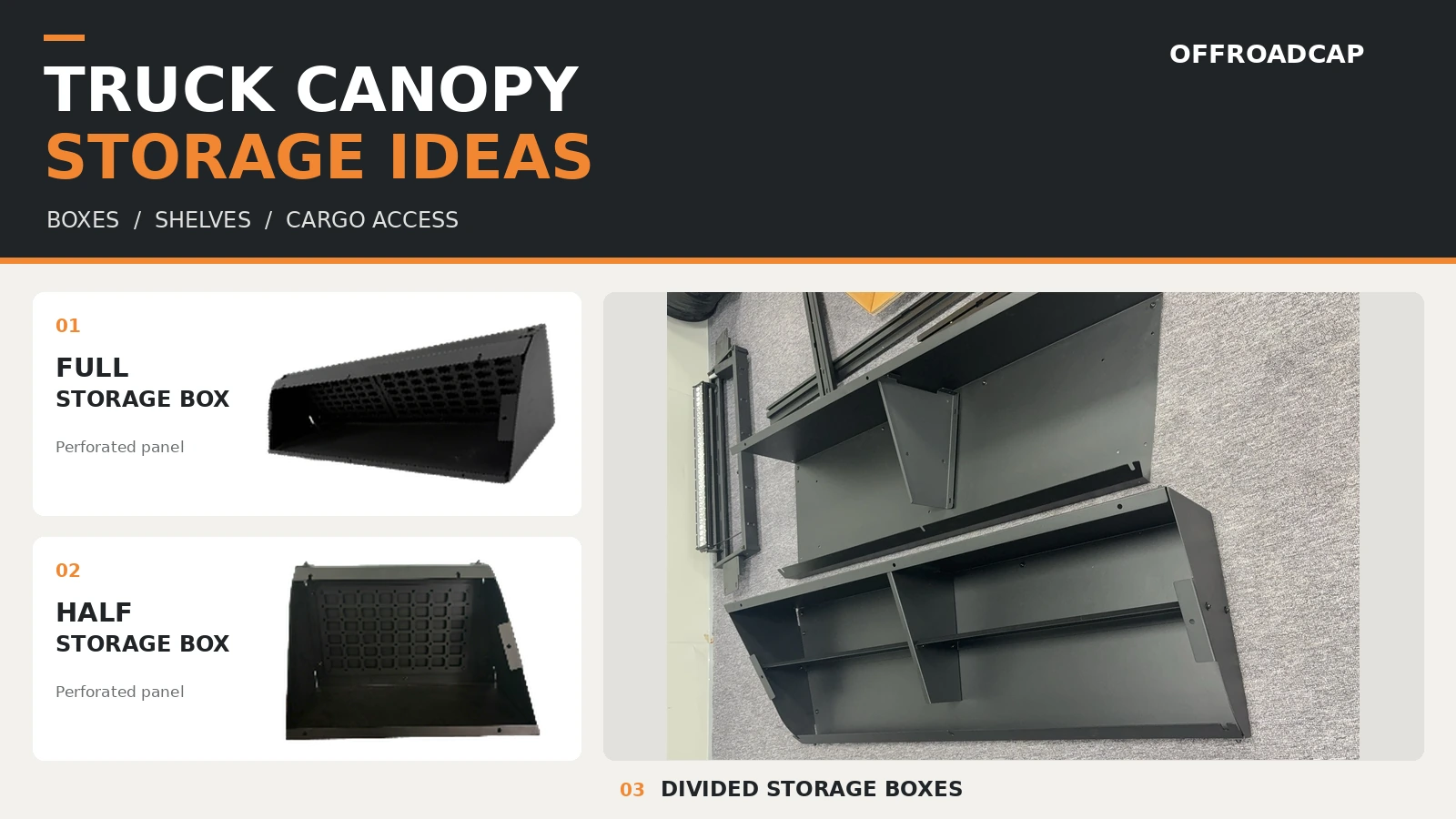
OFFROADCAP lists both full and half storage box options in its PB Series. The following figures come from the linked product specifications checked on October 15, 2026.
| Product | Listed models | Listed net weight per unit | Listed storage feature |
|---|---|---|---|
| PB Series full storage box | PB30159: small pickup; PB30156: big pickup | 9.7 kg for either listed model | Full storage with layered customization |
| PB Series half storage box | PB30160: small pickup; PB30157: big pickup | 5.8 kg for either listed model | Half storage without layered compartments |
The difference between these listed net weights is 3.9 kg per unit. That is an empty-product comparison. The two formats have different storage arrangements, so the weight difference alone cannot establish which suits your cargo.
Confirm compatibility with the selected vehicle, canopy series and mounting kit. Obtain installed outer dimensions, usable compartment dimensions and a loaded-weight limit for the quoted option. These details are needed to determine where the unit fits and what it can carry.
The product pages identify their dimensional entries as packing sizes. Use those entries for shipping discussions. Request an installation drawing for the storage layout instead of treating carton dimensions as the installed box dimensions.
Keep a Clear Route for the Largest Item
Side storage consumes part of the width available to cargo. Measure the narrowest usable section at the height where the largest item will pass, including wheel arches, brackets, handles and any projecting hardware.
For a preliminary layout in which two storage units project into the same cross-section:
Remaining central width = measured clear width before storage − left-side projection − right-side projection.
For example, assume a clear width of 1,400 mm, a left-side projection of 250 mm and a right-side projection of 300 mm:
1,400 − 250 − 300 = 850 mm remaining central width.
An 800 mm-wide case would leave a total width difference of 50 mm at that section. These are illustrative inputs, not OFFROADCAP dimensions or a recommended clearance. Check the case depth, turning movement, hand space, rear opening and final secured position as well.
Draw the storage arrangement from above and from the side. A plan view shows the central route; a side view shows lids, shelves and available height. Our truck canopy door and side-access guide explains how to check opening dimensions and panel movement alongside the storage layout.
Choose Boxes, Shelves and Storage Racks for Specific Tasks
Compare truck canopy accessories by the task they solve. Adding more compartments is useful only when the equipment remains accessible and the loaded assembly has an approved mounting arrangement.
Side boxes for frequently used equipment
When comparing truck caps with side tool boxes, check whether the compartment can be accessed fully through the opening. Verify lid clearance, latch access and the route for removing the largest tool case. Arrange partitions around the equipment you actually use.
A fixed storage box and a panel attached to a moving door need separate specifications. If equipment is carried on a door, have the supplier confirm the permitted attachment and loaded assembly, including the hinges and opening supports.
Shelves for smaller, separated items
A shelf can separate small cases from the main cargo area. Check shelf depth against the reach distance from the side opening, and specify how each item is retained during travel. Leave access to the canopy mounting hardware and any serviceable electrical components.
For a truck canopy storage rack inside the enclosure, identify its support positions and permitted load distribution. An interior rack or shelf requires its own specification. For equipment outside on the roof, use our separate canopy roof rack and load-capacity guide.
Overhead storage where the structure permits it
Truck canopy overhead storage can use space above the main cargo, but it needs approved attachment points and a retention method. Measure the remaining height below the loaded compartment and check interference with doors, lights and other fittings.
A high-rise roof creates additional interior height; it does not establish the load allowance for an internal shelf. Obtain the specification for the complete compartment, supports and attachment points. For a sleeping platform, also measure the space above the mattress using our canopy height comparison.
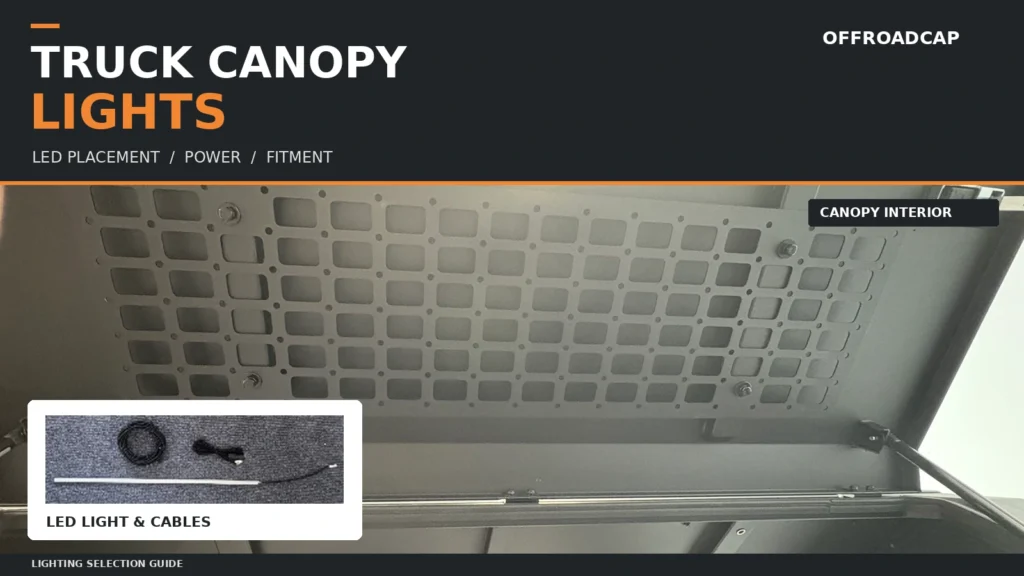
Storage can also create shadows. Read our truck canopy lighting guide to plan illumination around boxes, shelves and the areas where equipment is handled.
Include Storage Weight, Contents and Cargo Retention
The weight added by storage includes the unit, installation parts and its contents. Record each component once. Check which brackets or fittings are already covered by the supplied product weight before adding them again.
Loaded storage weight = empty unit weight + installation parts not already included + stored equipment.
For an illustration, use the published 9.7 kg full-box net weight, assume 2.3 kg of additional installation parts and assume 20 kg of contents. The resulting total is 9.7 + 2.3 + 20 = 32 kg. Only the 9.7 kg input comes from the listed product specification. The other inputs are assumptions, and the calculation does not establish that the box is approved to carry 20 kg.
Add the loaded storage to the complete vehicle weight budget, together with the canopy and any other equipment. Our truck canopy weight guide explains the distinction between product net weight, shipping gross weight and installed weight.
Ford’s 2026 Maverick Owner’s Manual, in its Load Carrying and Pickup Bed sections, explains that available space and payload are separate limits and that cargo must be secured. It also requires users to respect load-retaining fixture ratings. Use the manual and loading information for your actual vehicle when planning its installation.
Secure the storage unit and its contents using the approved arrangement. Closing a canopy door does not establish that a loose case or shelf-mounted item is restrained. Keep access to the required anchor points and inspect attachments according to the relevant instructions.
Separate Canopy Configuration From Optional Storage Equipment
When comparing truck cap accessories or camper shell accessories, keep the base canopy configuration and optional equipment on separate lines in the quotation. This makes it easier to see what is included and to repeat an approved build.
Confirm the canopy series, roof profile, left and right door arrangement, glazing and locking package first. Then list storage boxes, shelves, hanging panels, lighting and other optional equipment by part number. Check each item against the vehicle and canopy application.
For a distributor comparing truck camper shell accessories across several vehicles, a shared product name is insufficient to confirm interchangeability. Match the mounting interface, dimensions, opening position and supplied hardware for every application.
Before approving the storage package, request:
- Truck make, model, year, cab type, bed length and market identification.
- Canopy series and the left, right and rear access configuration.
- Storage part numbers, installed dimensions and usable compartment dimensions.
- Empty weights, included mounting parts and approved loaded-weight limits.
- Mounting drawings, attachment specifications and fitting instructions.
- A layout showing cargo routes, lid movement and access to service points.
- Replacement parts and the inspection requirements for the assembled setup.
Trial the complete layout with representative cargo. Open every door, lid and drawer that forms part of the proposed build, then remove and reload the largest items. Record the approved arrangement with photographs and a parts list before repeating it in a fleet or batch order.
Frequently Asked Questions
What are the best truck canopy storage ideas for a work vehicle?
Start with frequently used equipment beside an accessible opening, a clear route for larger items and compartments matched to actual tool cases. Confirm loaded weights, mounting and retention before choosing the package.
Is a full storage box better than a half storage box?
Compare the space and organization each provides against your cargo. OFFROADCAP lists full boxes with layered customization and half boxes without layered compartments. Obtain installed dimensions and load limits for the selected model.
Can I add overhead storage to any high-rise canopy?
Confirm that the selected canopy has an approved attachment arrangement for that compartment. Extra height alone does not establish structural capacity. Check remaining clearance and item retention as part of the complete design.
Do storage accessories increase vehicle payload capacity?
They add weight to the vehicle. Include the empty storage system, mounting parts and contents in the weight budget, and check the vehicle’s own loading limits.
Can I choose storage using the carton dimensions?
Use installed dimensions and usable compartment measurements for layout planning. Packing dimensions describe the shipping package and may differ from the assembled product.
Plan a Storage Layout for Your Truck
Browse the OFFROADCAP accessories range alongside your selected canopy. Send the truck’s make, model, year, cab type and bed length, plus the canopy series and intended door arrangement.
Include cargo dimensions and weights, daily access needs, required central space and order quantity. Send OFFROADCAP your canopy storage requirements to discuss compatible equipment and the drawings needed to evaluate your layout.