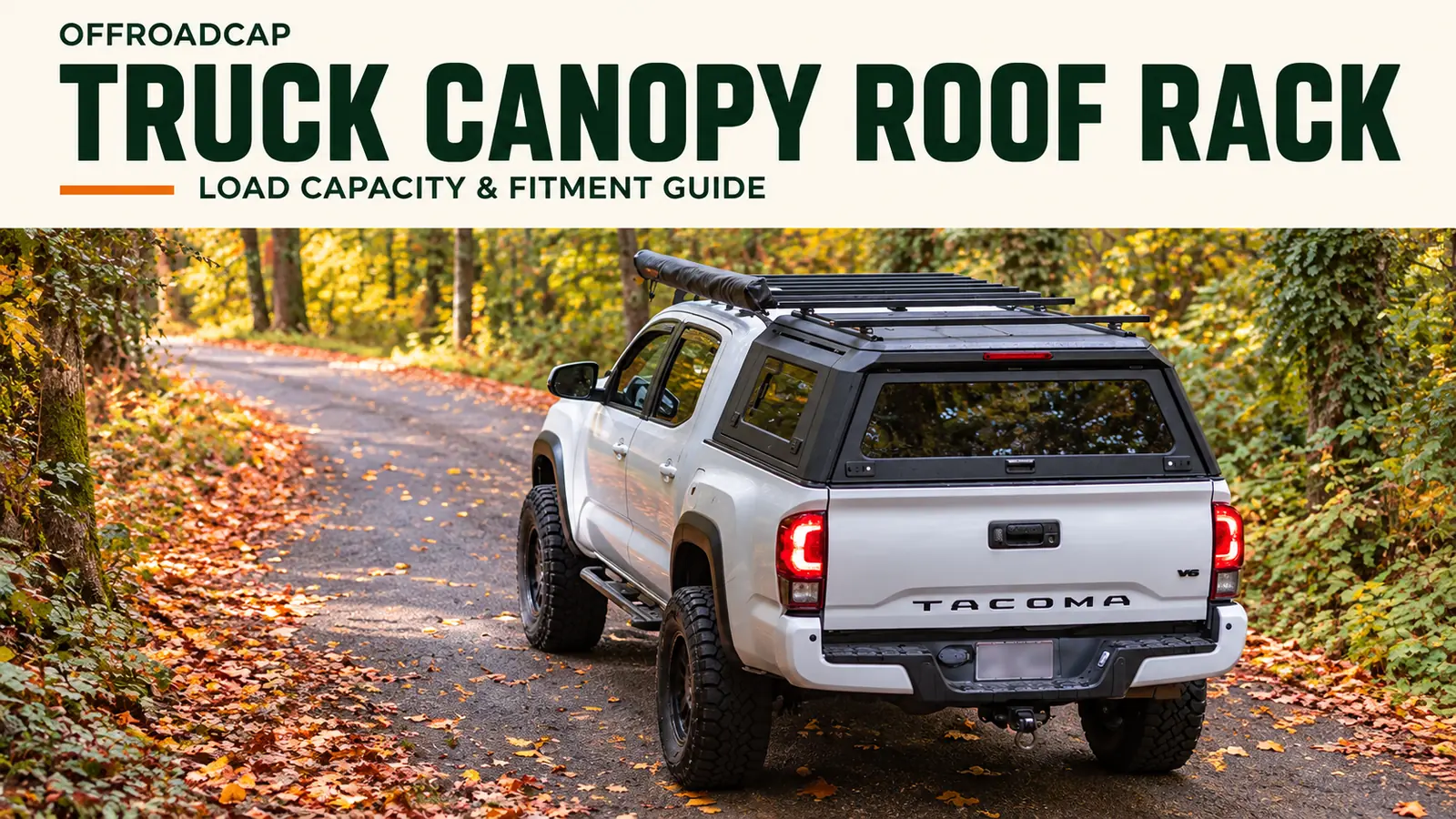
A truck canopy roof rack adds carrying space for ladders, outdoor equipment and compatible camping accessories above the pickup bed. Choosing the right setup starts with three questions: how the rack attaches, what the complete system can carry and which conditions the load rating covers.
Compare the canopy, mounting components, rack and intended cargo together. A headline capacity figure is useful only when its application and loading conditions are clear. For the wider buying checklist covering construction, doors, roof height and vehicle fitment, read our high rise truck cap buyer’s guide.
Choose a Truck Canopy Roof Rack Around the Cargo
Start with the equipment you actually need to transport. Record its weight, dimensions, loading frequency and attachment requirements. Long ladders need a different support arrangement from a roof box, and a rooftop tent adds requirements for both travelling and parked use.
Common rack arrangements provide different ways to support equipment:
| Arrangement | Typical purpose | Key fitment check |
|---|---|---|
| Crossbars | Supporting compatible carriers or equipment at defined points | Bar spacing, section dimensions and attachment compatibility |
| Roof platform | Providing a mounting area for several compatible accessories | Platform weight, support positions and accessory layout |
| Ladder rack | Supporting ladders and other long work equipment | Support length, load restraint and the rack’s structural mounting route |
When comparing a camper shell with roof rack options, check whether the rack loads the canopy structure or uses a separate bed-mounted support system. These arrangements have different fitting requirements. A rack positioned above a canopy is not necessarily attached to its roof.
Check Truck Canopy Roof Rails and Rack Mounts
The roof rails or designated fixing points connect the rack to the canopy. Their shape, spacing and supporting structure must match the proposed mounting kit. Ask for a drawing that identifies the approved attachment locations.
Our Ford Ranger 2023+ OC10115 canopy listing describes support for compatible roof racks and modular canopy accessories. Use the vehicle application as the starting point, then confirm the roof equipment and mounting arrangement for the configuration being ordered.
When checking truck canopy rack mounts, request the rail profile, bolt or channel-nut dimensions, fastener specification and mounting instructions. A matching thread diameter alone does not establish that the whole connection is suitable.
The supplied canopy specification discussed in our buyer’s guide describes standard mounting rails compatible with M8 cup-square bolts and accessories such as tie-down rings. Confirm that detail for the selected roof configuration, including the approved feet, fastener engagement and tightening requirements.
For a truck canopy with roof rack package, the quotation should identify both the enclosure and the roof equipment. Check whether crossbars, feet, hardware and accessory mounts are included or supplied separately.
Understand Dynamic, Static and Off-Road Load Ratings
A load figure should state the conditions in which it applies. Keep these terms separate when reviewing specifications:
- Dynamic load: the permitted load while the vehicle is moving, under the conditions specified for the system.
- Static load: the permitted load while parked. This matters for an occupied rooftop tent.
- Off-road load: the allowance or restrictions for the stated unsealed-road or off-road conditions.
Rack manufacturers distinguish these conditions because road movement and driving forces change how loads act on the system. Obtain the applicable ratings for the complete canopy and rack arrangement, with the intended route identified.
For canopy-mounted equipment, a cab-roof rating describes a different mounting location. Confirm the limits for the canopy structure, its connection to the truck bed and the vehicle’s applicable weight limits. Use the cab-roof rating when equipment is supported on the cab.
What Does a 150 kg Canopy Roof Figure Mean?
The supplied canopy design described in OFFROADCAP’s high-rise buyer’s guide lists a reinforced roof with a 150 kg load capacity. That figure belongs to the described configuration and needs its loading conditions before it can be used to plan accessories.
Request confirmation of whether the figure covers driving or parked use, how the load is distributed, which mounting system was used and whether rack weight is included. Ask for the applicable off-road conditions at the same time.
A complete specification should connect the number to the actual roof, rails, supports and vehicle installation. For a rooftop tent request, obtain confirmation for the proposed tent and rack combination, including occupied use.
Calculate the Complete Roof Equipment Weight
Count every item carried above the canopy: rack or platform, mounting components, accessory holders, tent or cargo box and the equipment inside it during travel. Keep a written component list so included hardware is counted once.
Check how each supplier defines its rating. A cargo-only allowance and a limit that includes the rack have different weight bases. Compare the canopy, rails, mounts and rack limits after making those definitions consistent.
Where the approved total roof-equipment limit includes the rack and its mounts, the calculation is:
Available cargo weight = applicable total roof-equipment limit − rack weight − mounting and accessory-support weight.
The following example uses assumed figures for calculation only. Replace them with the approved ratings and actual weights for your setup.
| Item | Assumed weight or limit |
|---|---|
| Total roof-equipment limit for the intended driving conditions | 100 kg |
| Rack | 18 kg |
| Mounting components and accessory supports | 7 kg |
| Remaining allowance for carried equipment and cargo | 100 − 18 − 7 = 75 kg |
In this example, a 60 kg tent plus 5 kg of gear carried inside it uses 65 kg of the remaining allowance. The arithmetic leaves 10 kg. The proposed equipment must also meet the approved support spacing, load distribution and application requirements.
Add the complete canopy, roof equipment and other fitted accessories to the vehicle weight budget. Our truck canopy weight guide explains net weight, installed weight and payload planning.
Choosing a Truck Canopy Ladder Rack
A truck canopy ladder rack should suit the ladder’s length, weight and loading routine. Check the permitted support spacing and overhang, how the ladder is restrained and whether the arrangement leaves practical access to the canopy doors.
With a ladder rack over a camper shell, establish which structure carries the load. A separate rack fixed to the truck bed needs its own approved mounting layout and clearance around the enclosure.
On pickups where the cab and bed-mounted canopy move independently, a rigid load fixed across both roof systems can stress the equipment. Have the installer confirm a suitable arrangement instead of treating separate cab and canopy racks as one continuous structure.
For fleet orders, give the supplier the dimensions and weight of the longest equipment to be carried. Include the expected loading frequency and routes so the rack proposal can be checked against actual working conditions.
Planning a Truck Canopy Roof Top Tent Setup
A truck canopy roof top tent setup needs confirmation for the canopy, rack, mounting hardware and tent together. Review the tent’s mounting instructions for crossbar spacing, bar dimensions and its permitted support arrangement.
Check the travelling weight with the tent closed, including mounting hardware and any bedding or other items left inside. For parked use, confirm the occupied-load conditions for the complete system and follow the tent’s instructions for ladder support and deployment.
Ask both suppliers to identify the intended combination. Useful information includes the canopy model, rack model, mounting-kit part numbers, tent model, travelling weight and intended number of occupants. A static allowance should come from the relevant system documentation.
Keep a copy of that confirmation with the installation records. It gives dealers and owners a clear reference when accessories are changed later.
Check Clearance and Installation Before Handover
Measure the finished vehicle height with the rack and carried equipment in place. Check covered parking, garage entrances and other restricted spaces on the route. A high-rise canopy changes the starting height before roof equipment is added.
Our high-rise vs. cab-high truck cap comparison explains roof-profile choices and clearance planning.
Follow the selected fitting instructions for attachment locations, torque and sealing. Check that rack feet and accessories clear the canopy doors, hinges and any nearby equipment.
Use our truck canopy installation guide to plan vehicle preparation and handover checks. Record the roof equipment fitted and the manufacturer’s inspection requirements, including checks after initial use or refitting.
Frequently Asked Questions
Can I add a roof rack to any truck canopy?
Confirm that the canopy has an approved mounting arrangement for the selected rack. Check its structural supports, attachment details and applicable load ratings. The enclosure’s dimensions and appearance alone do not establish compatibility.
Does a 150 kg roof rating confirm rooftop-tent suitability?
Confirm the loading conditions behind the figure and obtain approval for the complete tent setup. Travelling weight, occupied use, rack layout and the mounting system all form part of that assessment.
Can I calculate static capacity by multiplying the driving rating?
Use the static rating stated for the approved system. Obtain it from the canopy and rack suppliers rather than applying a general multiplier to a driving-load figure.
How do I choose a truck cap with roof rack equipment?
Compare the cap, mounting kit, rack and intended cargo as a complete package. Confirm included components, equipment weights, compatible mounting interfaces, load conditions and finished vehicle height.
Does no-drill canopy installation also cover the roof rack?
Confirm the roof-rack installation method separately. The canopy’s attachment to the truck bed and the rack’s attachment to the canopy are different interfaces, each with its own fitting requirements.
Request a Canopy and Roof Rack Configuration
Start with the OFFROADCAP pickup canopy range. Provide the truck model, year, market and bed dimensions, together with the proposed rack, cargo or tent.
Include equipment weights, intended routes, garage-clearance requirements and order quantity. Send your canopy and roof-equipment requirements to OFFROADCAP to discuss the applicable configuration and the supporting fitment information.