Truck canopy insulation can slow heat transfer, but its usefulness depends on the material, coverage and installation. A carpeted roof, a reflective sheet and a specified thermal lining are different configurations. Before choosing an insulated truck cap, ask what is fitted, where it is fitted and what evidence supports its performance.
Start with the problem you need to solve: a hot roof in the sun, cold interior surfaces, overnight condensation or a more practical interior finish. This guide explains how to compare insulation and liners without confusing them with rain sealing. For the wider enclosure specification, read our high rise truck cap buyer’s guide.
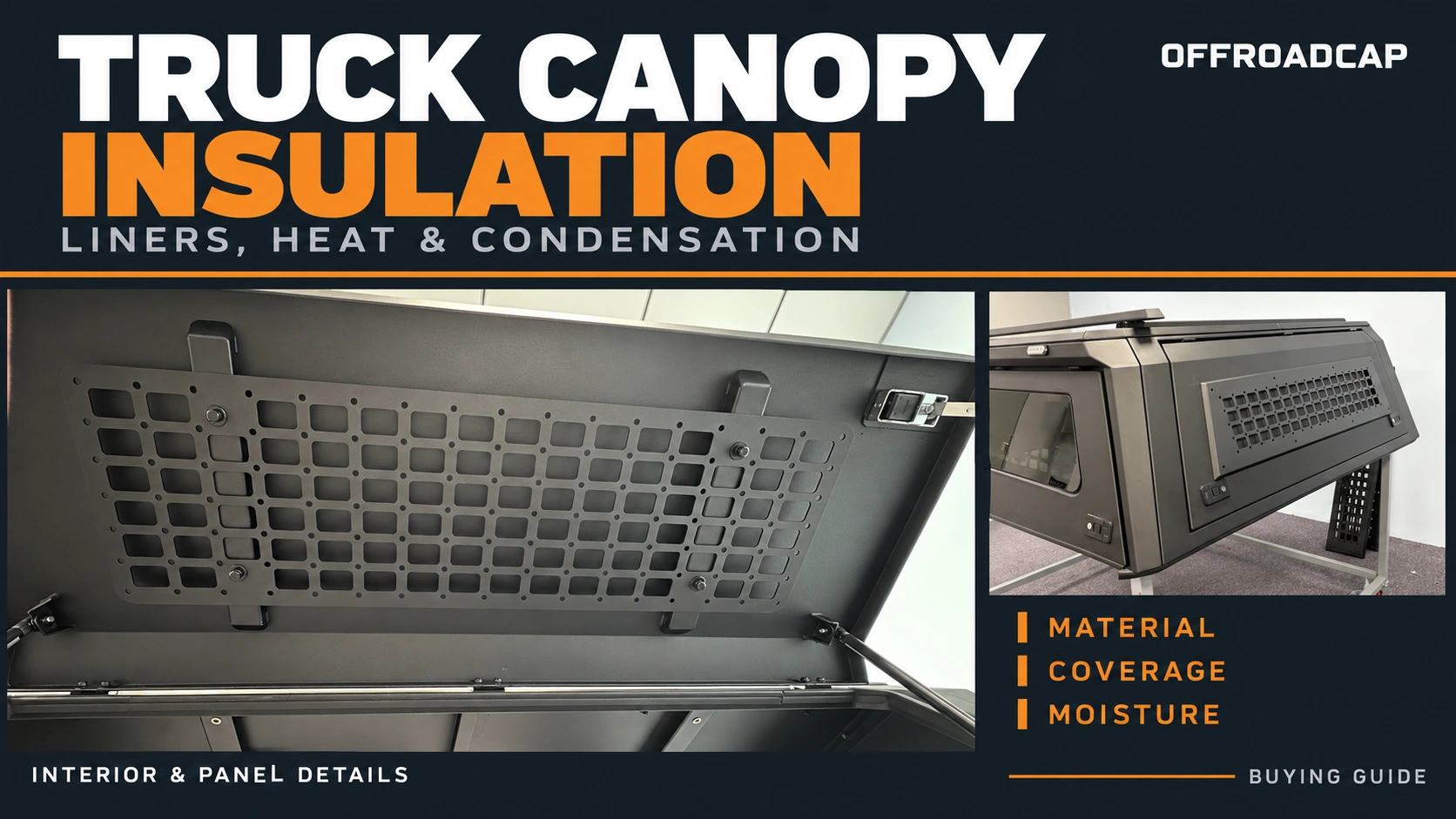
About this guide: The insulation and lining materials discussed below are general examples. They are not listed here as OFFROADCAP standard equipment or confirmed accessories. The main image shows metal interior panels and canopy structure; it does not show a verified insulation layer.
Insulated Truck Cap or Interior Liner: What Is Included?
An insulated truck cap should have an identifiable insulation specification. The word “lined” may describe only the visible interior finish. Ask for the layers behind that finish and a drawing of the areas covered.
| Description | What to establish | Evidence to request |
|---|---|---|
| Interior liner | Whether it is a finish, an acoustic treatment or part of a thermal assembly | Material identity, thickness, covered areas and stated function |
| Thermal insulation package | The insulation layers and how they fit around the structure | Material data, installed thickness and thermal-performance information |
| Condensation-control lining | How the arrangement addresses cold surfaces, moisture and drying | Intended conditions, installation details and inspection requirements |
| Insulated panels | Whether the description covers the roof, sides, doors or the complete enclosure | Panel construction, edge details and scope of any assembly test |
OFFROADCAP’s documented interior accessories include metal MOLLE panels for equipment organization. These are mounting panels, not thermal insulation or fabric linings. If an aftermarket lining is proposed, ask the canopy supplier and lining installer to review attachment, clearance, service access and warranty requirements before work begins.
Why Truck Canopy Condensation Happens
Condensation can occur when an interior surface reaches or falls below the dew point of the adjacent air. The U.S. National Weather Service explains dew point as the temperature at which air reaches saturation when cooled at constant pressure.
Applied to a canopy, this means a cold roof or frame can become wet even when rain is not entering through a joint. Wet equipment also introduces a moisture source. Whether droplets develop depends on the interior moisture conditions and the temperature of the particular surface.
For illustration, suppose the interior air has a dew point of 12°C. An exposed surface at 8°C is below that threshold, while a surface at 15°C is above it. These are assumed conditions to explain the mechanism, not measurements or performance claims for an OFFROADCAP product.
Insulation manufacturer Armacell’s condensation-control guidance connects insulation design with maintaining the exposed surface above dew point and limiting moisture ingress. That guidance concerns technical insulation systems; it does not establish a universal material or thickness for pickup canopies.
Is the Water Coming From a Leak or Condensation?
Record when the moisture appears and where it first becomes visible. These observations help narrow the investigation, but they are not a diagnosis on their own.
- After rain or washing: investigate the relevant door, window, panel joint or canopy-to-bed interface.
- After a cold night without rain: record the roof and frame temperatures, interior humidity and any wet cargo.
- Behind a lining: ask the installer to assess the concealed surface, bonding and possible water entry before covering it again.
- Only around one opening: check that opening and its adjacent structure; both local condensation and external ingress may need investigation.
Use our truck canopy seal guide for the external water-entry checks. Additional insulation will not repair a damaged window seal, and additional sealant will not resolve every condensation problem.
Comparing Camper Shell Insulation Materials
For camper shell insulation, compare a documented installation rather than choosing by surface appearance. Ask the supplier how the proposed material will work with the canopy’s coating, frame, openings and service access.
Carpet or fabric liners
A camper shell liner may be specified primarily as an interior finish. If thermal or acoustic benefits are claimed, request the relevant data for that product and thickness. A soft surface does not, by itself, establish an R-value or condensation-control result.
Check cleaning instructions, drying arrangements, edge finishing and whether sections can be removed for inspection. Ask what happens if moisture reaches the surface behind the liner.
Foam or layered thermal linings
Request the exact material, installed thickness, moisture-related properties and attachment method. Identify any facing, adhesive and protective finish as separate parts of the assembly.
“Closed-cell” is a material description, not proof that the complete canopy cannot develop condensation. The joints, exposed structure and remaining uninsulated areas still need assessment.
Reflective insulation
A reflective surface requires the appropriate installation geometry. The U.S. Department of Energy’s insulation overview explains that reflective systems require an adjacent air space to perform their radiant-heat function.
For a canopy proposal, ask where that space will be maintained and how the supplier substantiates the installed performance. Do not treat a foil layer bonded directly between solid surfaces as equivalent to a tested reflective assembly with an air space.
Truck Canopy Insulation: Read Beyond Material Thickness
R-value describes resistance to heat transfer. A material value is useful only when its thickness, units and test conditions are identified. It also needs to be distinguished from the performance of the finished enclosure.
The Department of Energy’s high-R insulation guidance highlights the importance of installation continuity, avoiding gaps and compression, and minimizing thermal bridging. These are general insulation principles from building guidance, not canopy certification requirements.
When assessing an insulated truck topper, ask how the proposed lining treats the roof edges, frame members, doors and window surrounds. Request a coverage drawing that identifies exposed areas. A roof-only material test should be described as such.
If a supplier promises a temperature reduction, request the comparison conditions: sunlight, ambient temperature, starting temperature, duration, ventilation and sensor positions. A single interior photograph or an isolated temperature reading cannot describe performance across different climates.
Check Interior Space, Weight and Hardware Access
Insulation and its finish occupy space. Compare the final usable dimensions with the cargo, shelves and door openings that matter to your operation.
For a simple dimensional example, a 10 mm lining projecting inward from each of two opposite walls reduces the clear width between those faces by 20 mm. A 10 mm roof lining reduces headroom beneath that surface by 10 mm. These assumed dimensions illustrate clearance changes; they are not a recommended thickness or an OFFROADCAP specification.
- Confirm clearance for hinges, gas struts, latch travel and removable access panels.
- Retain access to the mounting hardware described in our truck canopy clamps and fitment guide.
- Check the finished dimensions against your canopy storage layout.
- Include the lining, adhesive, trim and supporting parts in the configured weight. Our truck canopy weight guide explains the wider weight budget.
Have the installer confirm material and adhesive compatibility with the actual coated surfaces and intended service temperatures. Follow the specified preparation and curing instructions rather than transferring a method from a different enclosure.
Plan Moisture Management Alongside Insulation
Document how wet cargo will be handled and how the enclosure will dry after use. Where practical, remove wet equipment for drying instead of leaving it against the interior lining.
Ventilation can assist drying when the incoming air has a lower moisture content, but its effect depends on the conditions. This follows from the relationship between air moisture and dew point; it is not a guarantee that any open vent prevents condensation.
Discuss approved ventilation arrangements with the canopy supplier. Identify any water-management paths that must remain clear and check how a proposed vent affects rain protection and dust management. Do not cover a drainage route or modify a structural panel without the applicable fitting instructions.
What Dealers and Fleet Buyers Should Request
For an insulation proposal from a supplier or aftermarket installer, provide the vehicle application, intended cargo, operating climate and whether the vehicle carries wet equipment. Evaluate that proposal separately from the canopy’s confirmed equipment list. Request:
- A defined package: material identity, thickness and a roof, wall and door coverage drawing.
- Performance evidence: thermal data with units and conditions, with material tests separated from complete-assembly tests.
- Installation details: surface preparation, attachment method, edge treatment and service access.
- Material suitability information: temperature limits, moisture properties, cleaning instructions and applicable fire-performance documentation for the intended use.
- Finished dimensions and mass: changes to openings, headroom, storage clearance and configured weight.
- After-sales information: inspection, drying, repair and replacement arrangements, including the effect of later modifications on warranty coverage.
For repeat orders, keep the approved material and installation revision with the vehicle configuration record. Similar-looking liners should not be substituted without checking the agreed specification.
Frequently Asked Questions
Does an aluminum truck canopy need insulation?
The decision depends on the operating conditions and the problem being addressed. Compare a documented thermal package when heat transfer or cold surfaces matter; assess interior finishes separately when appearance and cleaning are the priorities.
Does a truck canopy liner stop condensation?
A liner description alone cannot establish that result. Check the material, coverage, interior moisture conditions and exposed cold surfaces. Ask for evidence under conditions relevant to your use.
What is the best thickness for truck canopy insulation?
There is no single thickness for every material and climate. Confirm the required performance, available space, installation details and compatibility with the canopy before selecting a package.
Will an insulated camper shell keep cargo at a fixed temperature?
Insulation slows heat transfer; it does not establish temperature control. For temperature-sensitive cargo, define an acceptable range and verify the complete setup under the intended conditions.
Can insulation be added after the canopy is installed?
Ask the canopy supplier and installer to review the proposed material, coating compatibility, attachment method, hardware clearance and service access. Confirm modification and warranty requirements before work begins.
Discuss Your Canopy Fitment and Sealing With OFFROADCAP
For canopy selection or an external water-entry enquiry, send OFFROADCAP the truck make, model, year and bed size, along with cargo needs and clear photographs of the relevant seals or mounting interfaces. If dampness is the issue, describe when it appears and whether it follows rain, washing or an overnight temperature change.
Contact OFFROADCAP about vehicle fitment, canopy sealing and documented accessories. For a separate insulation or lining proposal, obtain specifications and installation approval from the relevant suppliers before ordering or modifying the enclosure.