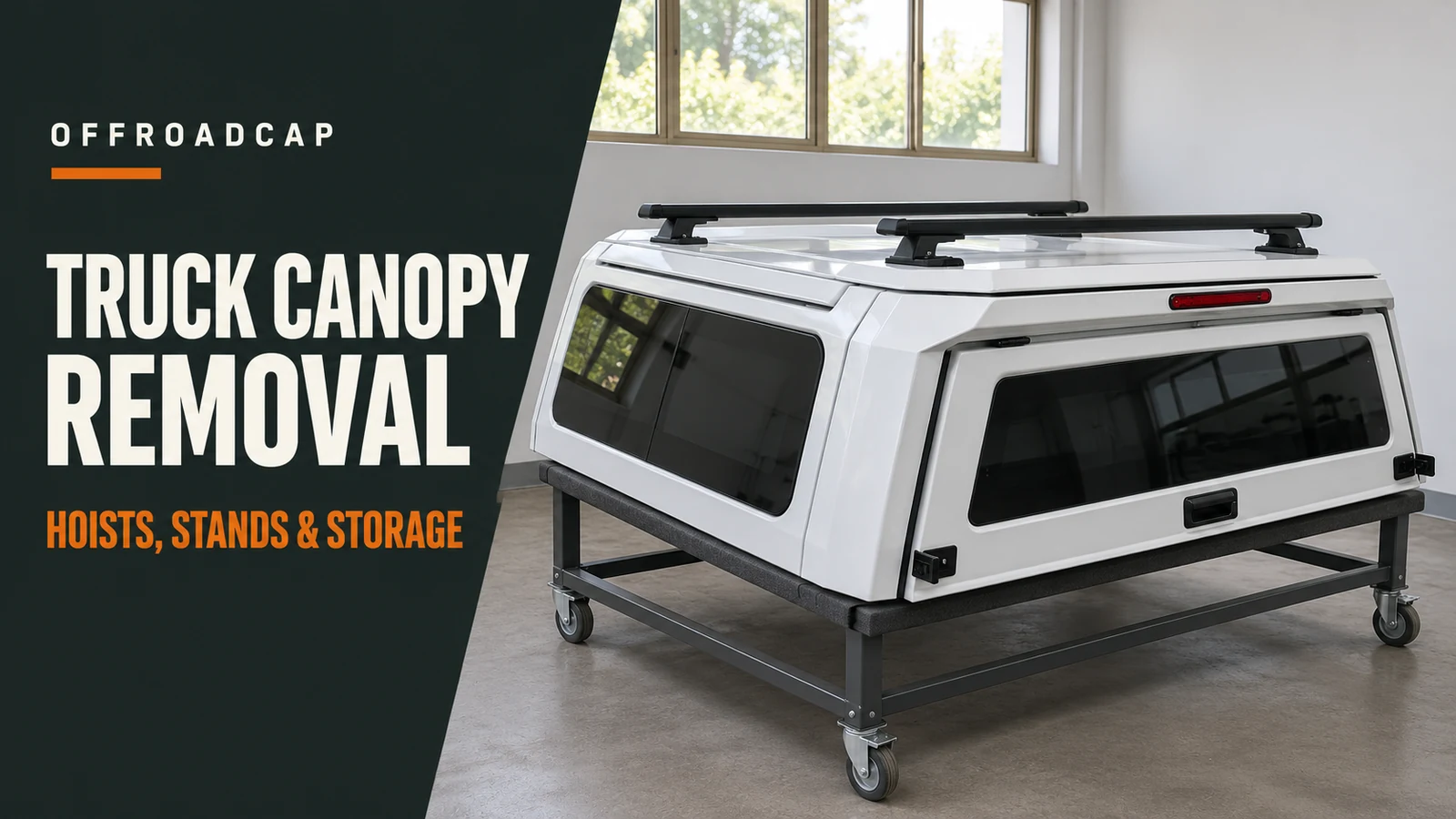
Truck canopy removal gives you access to an open bed for furniture, landscaping materials or equipment that will not fit through the rear door. The job needs a destination for the canopy, a way to move it there and a plan for putting it back.
Start with the complete fitted enclosure. A roof rack, awning, electrical harness or internal storage unit can change what must be disconnected, how much will be lifted and where the canopy can be supported. Set up the storage position before releasing the vehicle mounts.
This guide uses OFFROADCAP model specifications and worked examples to help owners and installers plan the job. The actual lifting points, support arrangement and fastening sequence must come from the instructions for the selected canopy and handling equipment.
Start With the Weight That Will Actually Leave the Truck
OFFROADCAP publishes model-specific weights. The Ford Ranger 2023+ OC10115 lists a net weight of 42 kg. The Ford F150 5.5FT OC20109 lists 56.34 kg. These provide a starting point for identifying the product on your truck.
| Model and listed application | Net weight | Gross shipping weight |
|---|---|---|
| OC10115 — Ford Ranger 2023+ | 42 kg | 51 kg |
| OC20109 — Ford F150 2015+ 5.5FT | 56.34 kg | 62.64 kg |
Confirm what the net figure includes for your order. Then list everything that will remain attached during removal. Roof equipment, internal fittings and any retained brackets belong in that calculation. Equipment that stays independently secured to the truck bed does not travel with the canopy.
For an illustrative OC20109 setup, assume the quoted 56.34 kg includes the standard enclosure and hardware. A separately added 18 kg rack and 12 kg empty roof box would bring the canopy-side total to 86.34 kg. Those accessory figures are examples, not OFFROADCAP specifications. Removing only the cargo inside the box would leave both accessories in the lifting load.
Verify the finished load and the handling equipment’s capacity requirements before selecting a system. Our truck canopy weight guide explains the different weight definitions in more detail.
Choose a Truck Canopy Removal System Around Your Workspace
The best arrangement depends on how often you need the bed open and where the enclosure will stay. An owner removing a cap once a year may prefer a booked workshop lift and floor storage. A frequent changeover needs a repeatable handling arrangement with clear access to connections and mounts.
| Arrangement | Useful when | Resolve before removal |
|---|---|---|
| Installer-managed removal and floor storage | Removal is occasional or suitable lifting facilities are unavailable at home | Transport, storage responsibility, support method and the refitting appointment |
| Ceiling hoist with suspended storage | A suitable overhead structure and clear parking position are available | Complete load, canopy attachment, structural mounting, travel and stored clearance |
| Suitable lifting equipment followed by a floor stand | Overhead storage is impractical and floor space is available | Transfer method, support geometry, stand rating and access around the stored enclosure |
A truck canopy removal system should cover the transfer between truck and storage. A stand provides somewhere to put the enclosure, but you still need a method of getting it onto the stand. An overhead system needs enough travel to separate the canopy from the bed and leave a clear route for the vehicle.
Check a Truck Canopy Hoist Beyond Its Advertised Capacity
A truck canopy hoist needs to match the load, the building and the canopy connection. As one published example, Hoister Direct’s 7803.12 truck-cap system lists a 20–66 kg working range and a 12 ft ceiling-height version.
The illustrative 86.34 kg F150 arrangement above exceeds that listed maximum. Even the 56.34 kg catalogue figure falling within the range would establish only a weight comparison. The lifting attachment, structure, clearances and complete configuration still need confirmation. This example does not establish compatibility between that hoist and OC20109.
Different products also connect differently. Garage Smart’s Truck Top Lifter describes purpose-made brackets for specified cargo rails. That is a feature of its system. A roof rail on another canopy requires confirmation as a lifting interface before being used that way.
Send the equipment supplier photographs and the canopy identification, together with the verified lifting mass and proposed attachment. Obtain the canopy supplier’s matching handling information. Keep doors, handles, gas struts and glazing outside the proposed lifting arrangement unless the model instructions explicitly identify them for that purpose.
Measure the Lift Path and the Stored Height
Measure the installed canopy, the highest retained accessory, the ceiling and the open garage door. Include door tracks, lighting, beams and the space occupied by the lifting equipment itself. A truck entering the garage successfully does not show that its canopy can be lifted and stored there.
Garage Smart publishes a fully raised frame position 13 inches below the ceiling for its Truck Top Lifter. Using that system’s stated measurement method, a hypothetical 30-inch-high suspended item would occupy 43 inches below the ceiling. The 30-inch item is an illustration, and the 13-inch allowance applies to that product.
In a 96-inch-high room, that example leaves 53 inches beneath the stored item. Compare that result with the actual vehicle and garage-door movement. It would not provide clearance for a 70-inch-high vehicle to pass underneath. Also check the equipment’s downward travel if you intend to lower the enclosure onto a stand.
If overhead storage fails these measurements, plan a floor-storage position or use a workshop service. Changing the destination before the job is easier than finding a new route with the canopy already detached.
Prepare Connections and Hardware Before Releasing the Mounts
Photograph the fitted canopy from all sides and record each mounting position. Label photographs by vehicle side and location. This makes a later hardware query or refitting inspection easier, particularly if several canopies are stored in the same workshop.
- Clear the contents. Remove loose cargo and identify accessories that will be detached separately. Recalculate the retained load after those changes.
- Map the connections. Identify fitted brake-light, interior-light, powered-lock and other wiring. Have the relevant supply isolated and connectors separated using the applicable electrical instructions. Protect and label the disconnected ends.
- Prepare the destination. Position the selected support or complete the overhead-system checks. Clear the transfer route and agree who will operate the equipment and observe clearances.
- Follow the model-specific release procedure. Use the prescribed handling support and fastening sequence. Keep canopy-to-truck hardware separate from rack and internal-accessory hardware.
If a connection cannot be identified or the specified handling arrangement is unavailable, leave the enclosure secured until the installer resolves it. Wiring, seal adhesion or a hidden attachment can resist separation after the visible mounts are released. Stop if the canopy catches or rises unevenly and have the cause identified. Keep everyone clear of the suspended enclosure and follow the lifting system’s storage-securing instructions.
Use the canopy mounting guide to identify hardware and the installation guide when preparing the return to the vehicle. Neither replaces the selected model’s removal instructions.
Select a Truck Topper Stand for the Actual Support Layout
A truck topper stand needs a suitable load rating and contact positions that match the canopy’s approved support arrangement. Send the stand supplier the required support drawing and the stored enclosure’s dimensions. Confirm how pads, crossmembers and restraints will contact the structure.
When choosing a truck canopy stand for off-truck storage, check its assembled load rating, the distance between supports and the floor space it needs. If it has casters, include their rated arrangement, wheel locks, floor condition and permitted movement with the load in place. A rating printed on an individual wheel does not establish the capacity of a complete rack.
Draw the enclosure and stand footprint on the floor before ordering. Add room for the transfer, access to locks and inspection of contact points. Check whether retained brackets or a ladder project beyond the main enclosure. Leave those projections clear of walls and passing equipment.
Agree the storage orientation with OFFROADCAP for the selected model. Do not infer that an assembly can rest on its roof or stand vertically because it was delivered in separate cartons. Transport packaging dimensions describe the shipment, and cannot establish the support needs of an assembled canopy.
Store the Canopy With Its Next Installation in Mind
Clean and dry the enclosure using the specified care method before storage. Inspect the base, coating, seals and wiring while they are accessible. Photograph damage or compressed seal sections so replacement parts can be identified before the next fitting appointment.
Bag the vehicle mounts by position and keep them with the canopy identification and fitting instructions. Record which spacers or adapters belong to that truck. A similar-looking bracket from another vehicle should remain separately labelled.
For outdoor storage, obtain a suitable weather-protection and restraint arrangement for the enclosure and stand. Consider wind exposure, drainage and security as part of that plan. Avoid allowing a cover or restraint to load a door, window or unsupported panel.
Before refitting, check whether seals and fasteners are reusable under the model instructions. Inspect the truck’s mounting surfaces, restore the approved attachment and reconnect electrical equipment correctly. Test doors, locks and lighting, then complete the specified fitment and water checks. Record any required follow-up inspection.
Give Dealers a Repeatable Changeover Record
For dealer-managed truck canopy removal, use a separate job record for each vehicle. An OC20109 record should identify the exact F150 application and current equipment. An OC10115 record should retain its own Ranger mounting and support information. Similar appearance should never merge the two jobs into one unverified procedure.
A useful handover record contains six groups of information.
- Identification. Truck details, canopy model and original order reference.
- Removed equipment. The roof box, cargo and accessories detached before the lift.
- Retained equipment. Every item travelling with the enclosure and the verified complete load.
- Handling arrangement. Equipment identification, applicable instructions, attachment and storage-support details.
- Service parts. Labelled mounting hardware, electrical connectors and seals requiring replacement.
- Refitting result. Attachment inspection, door operation, electrical checks and the required follow-up.
Book the return installation while arranging removal if the truck is needed for a specific job. This lets the installer obtain replacement seals in advance and prevents stored hardware from becoming an unidentified box of parts.
Frequently Asked Questions
How do I remove a truck canopy by myself?
Establish whether the complete canopy and handling system are approved for single-operator use. A published canopy weight cannot answer that question. Where the necessary equipment, instructions or workspace are unavailable, arrange an installer-managed removal.
Can a roof rack be used to lift the canopy?
Only where the particular rack-to-canopy arrangement and lifting connection are approved for the job. A driving roof-load rating does not establish an upward lifting rating. Provide both suppliers with the exact hardware and mounting configuration.
Does a floor stand remove the need for a hoist?
A stand supplies a storage destination. The transfer still needs suitable handling equipment or the approved assisted method. Plan the movement between the truck and stand before releasing the vehicle attachment.
Can I dismantle a modular canopy for storage?
Ask whether repeated disassembly is permitted for that model and which seals, fasteners or alignment checks it requires. Separate roof and main cartons in a catalogue do not establish a routine dismantling procedure.
Plan Removal When Specifying Your OFFROADCAP Canopy
If an open bed is part of your regular work, include that requirement in the original canopy enquiry. OFFROADCAP’s vehicle-specific listings and published weights give buyers a defined starting point. Connect that specification to the actual accessories, workspace and intended storage position.
Send OFFROADCAP your vehicle and canopy details, removal frequency, retained-equipment list, garage measurements and proposed handling arrangement. Request the model-specific removal instructions, lifting-attachment details and off-truck support drawing before choosing equipment. Dealers can retain the confirmed configuration and handover record for repeat jobs, making future truck canopy removal easier to plan.