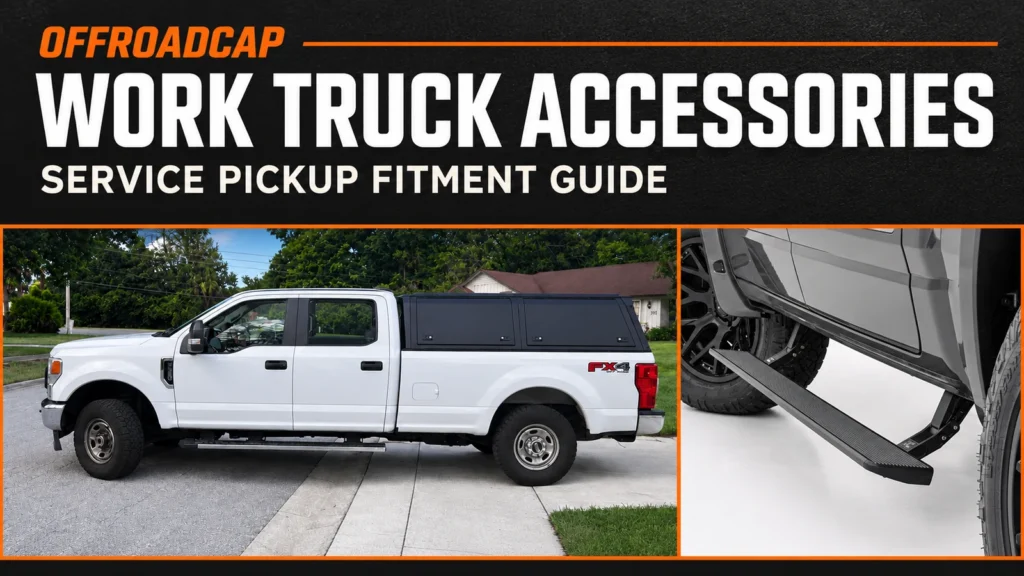

Choose commercial truck caps around the work the pickup must perform. The right configuration should let the crew reach everyday tools, load larger equipment, close and lock every opening, and check the vehicle before it leaves the yard.
A contractor, mobile technician and fleet buyer may start with the same vehicle but need different equipment packages. This guide explains how to turn those requirements into a clear specification using documented OFFROADCAP storage and hardware examples. For the complete enclosure, begin with our aluminum truck canopy buyer’s guide.
Start With the Job, Vehicle and Cargo
Before comparing work truck caps, write a short description of a normal working day. Record the tools used at each stop, the largest item transported, who needs access and where the truck is usually parked. Include equipment that stays on the vehicle overnight and anything carried only for occasional jobs.
Add the exact vehicle make, model, year, cab type, bed specification and destination market. Record existing bed liners, tie-downs and other equipment that may affect installation. A fleet can contain several bed or vehicle versions even when the trucks share a model name.
For each regularly carried item, note its packed dimensions, loaded weight and retrieval frequency. Include handles and attached fittings. These details give the supplier a useful basis for choosing the canopy, openings and storage arrangement.
Specify a Contractor Truck Cap Around Daily Access
A contractor truck cap should suit the way the crew loads and retrieves equipment. Check both the clear door opening and the space available beside the parked vehicle. A side opening is useful only if the worker can reach the intended compartment and remove its contents.
| Work requirement | Configuration to discuss | What to demonstrate on the sample |
|---|---|---|
| Retrieve small tools at frequent stops | A side-access storage location matched to the tool cases. | Remove a complete case without unloading unrelated equipment. |
| Carry occasional bulky equipment | A clear rear loading route alongside the selected storage. | Load the largest item through the narrowest part of that route. |
| Carry long equipment on the roof | A compatible rack, supports and equipment-retention arrangement. | Confirm the approved mounting configuration and applicable load limits. |
| Work in low light | Interior lighting positioned around the actual compartments. | Read labels and retrieve tools with the normal cargo loaded. |
| Share the vehicle between crew members | A documented key or powered-locking arrangement. | Operate every fitted lock and confirm the agreed access method. |
Use our canopy side-door and hardware guide when comparing openings and door movement. Specify which access positions are required on the order rather than assuming that every canopy photograph represents the quoted layout.
Build a Work Truck Canopy With Documented Storage Options
OFFROADCAP’s product catalogue lists full storage boxes, half storage boxes and versions with separator plates. The following references provide actual starting points for a work truck canopy enquiry.
| Catalogue option | Internal references | Selection question |
|---|---|---|
| Full storage box with perforated panel | HM0159 for small pickups; HM0156 for big pickups. | Does the installed box suit the tools and leave the required central loading route? |
| Half storage box with perforated panel | HM0160 for small pickups; HM0157 for big pickups. | Which equipment belongs in the box, and what needs to remain in the adjoining space? |
| Full storage box with separator plate | HM0247 for small pickups; HM0215 for big pickups. | Do the actual compartment dimensions suit the cases, consumables and dividers required? |
These are catalogue references, not a universal fitment list. Confirm the storage version, installed dimensions, mounting arrangement and permitted loaded weight for the selected canopy. Keep the internal HM references distinct from the PB references used on public product pages unless the supplier confirms their relationship.
The published full storage box and half storage box listings provide further product information. Neither the word “full” nor “half” establishes the usable space remaining in a particular truck. Our canopy storage planning guide covers the detailed layout checks.
Ask for a Quote That Separates the Cap, Options and Vehicle Work
When comparing a commercial truck topper quotation, ask for a written equipment list. The canopy enclosure, mounting kit, internal storage, roof equipment and electrical package should each have an identifiable specification and supply scope.
- Base enclosure: vehicle application, roof profile, door layout, windows, finish and mechanical locking.
- Mounting: approved canopy-to-bed hardware, required interfaces and any preparation needed for existing accessories.
- Interior equipment: storage references, quantities, positions and attachment hardware.
- Electrical equipment: lights, switches, powered locks, controllers and included wiring.
- Vehicle-side work: installation responsibilities, supply connections and the checks needed before handover.
Mark whether each item is factory fitted, supplied loose or installed locally. Confirm what is excluded and which drawings or instructions accompany the order. This makes two quotations easier to compare and helps an installer understand what will arrive.
For repeat orders, retain the approved configuration reference and revision. If the vehicle or equipment changes, review the affected parts before applying an earlier specification to the next batch.
For the commercial comparison, use our truck cap price guide to review packaging, transport and local work alongside the supplier’s unit price.
Check Installed Weight and Roof Equipment Together
When comparing aluminum commercial truck caps, review the weight of the complete working setup. Include the enclosure, mounting hardware, empty storage units, rack, electrical equipment and everything carried inside or above the canopy.
For a documented example, the public listings give the PB30156 big-pickup full storage box a net weight of 9.7 kg and the PB30157 big-pickup half storage box a net weight of 5.8 kg. These are listed empty-product weights. They do not state the permitted contents weight, the weight of another model or the remaining payload of the finished vehicle.
Use those figures only for the corresponding quoted products, then confirm the fitted assembly. Our canopy weight guide explains how to separate product, shipping and installed weights.
Roof-carried equipment needs a separate check. Confirm the selected canopy, rack, brackets, retention hardware and applicable driving or parked-load conditions. Include the rack and its attachments in the roof load. The roof-rack load and fitment guide explains the questions to resolve before ordering.
Evaluate Work Truck Toppers With a Loaded Sample
Before approving a repeat order, evaluate the proposed setup on the correct vehicle with representative cargo. A practical sample review should reproduce the tasks in the original work brief.
- Load and remove the largest equipment case through the intended opening.
- Retrieve frequently used tools from each specified compartment.
- Check that loaded storage and attached equipment clear the doors, hinges, latches and wiring.
- Close, lock and reopen every access point using the agreed key or control arrangement.
- Check interior visibility with the normal cargo in place.
- Record the accepted configuration, photographs and any changes needed before repeat supply.
Use the reinforced canopy lock guide to review the complete locking assembly. For illumination, the canopy lighting guide covers lamp placement and electrical details.
Agree on measurable acceptance criteria for the order, such as the equipment that must pass through an opening and the parts included in each package. Record observed results. A photograph of a sample does not establish a quantified security rating, weather rating or productivity improvement.
Keep a Service Record for Each Fleet Configuration
A commercial truck canopy also needs a practical service record. Keep its identification, equipment list, fitted positions, installation instructions and component photographs together. Record the key arrangement and the versions of any electrical controls.
For a mixed fleet, connect each vehicle to its approved canopy configuration. Similar-looking work truck toppers can use different storage, locks or mounting parts. Ask the supplier to identify approved substitutions before combining spare stock.
Our truck cap replacement-parts guide explains the photographs and identification details to collect for a service enquiry. Confirm spare-parts availability, order quantities and lead times for the selected configuration.
Frequently Asked Questions About Commercial Truck Caps
Does a commercial cap quotation include tool storage?
Confirm the written equipment list. Storage boxes, dividers, lighting and powered locks may be separate configuration items. Identify the supplied references, quantities and installation responsibilities.
Can the same configuration be used across an entire fleet?
Use it only for the confirmed vehicle and equipment applications. Check model year, cab type, bed specification, mounting interfaces and working requirements before repeating an order.
Should a work canopy use full or half storage boxes?
Choose around the equipment and access route. Compare installed dimensions, usable compartments, permitted loads and the space remaining for larger cargo. Trial the proposed arrangement with actual cases.
Discuss Commercial Truck Caps With OFFROADCAP
Send the vehicle details, working tasks, equipment dimensions and loaded weights, preferred access positions and required order quantity. Add roof-equipment requirements and identify whether storage and electrical equipment should be factory fitted or installed locally.
Contact OFFROADCAP to discuss a work-truck canopy configuration. Our team can review the application and discuss the available product options, fitment information and quotation.