Choosing a pickup truck canopy manufacturer involves much more than comparing product appearance and price.
Two canopies may look similar in photographs but perform very differently after long-distance shipping, outdoor exposure, repeated door operation, and off-road driving. Coating failure, water leakage, inaccurate fitment, weak roof structures, and unsuitable packaging are among the most common problems importers may encounter.
Before selecting a canopy supplier, buyers should evaluate the following five technical areas.
1. Coating and Corrosion Protection
Surface treatment is one of the most important indicators of long-term canopy quality.
A basic factory may apply only a single layer of conventional paint. Although the finish may look acceptable when the product leaves the factory, rust, peeling, fading, or blistering can appear after exposure to rain, salt, sunlight, and temperature changes.
A professional manufacturer should use a coating process suited to the substrate.
For steel parts, the process may include automotive-grade electrophoretic coating, also known as E-coating, followed by UV-resistant powder coating. Aluminum components should receive appropriate cleaning and chemical pretreatment before powder coating to improve adhesion and corrosion resistance.
Buyers should check:
- Surface pretreatment process
- Powder coating type and manufacturer
- Dry film thickness
- Coating adhesion results
- Coverage around welds, edges, hinges, and mounting points
- UV and color-fading resistance
- Salt spray test reports
Salt spray testing is commonly performed according to standards such as ASTM B117 or ISO 9227. Depending on the product specification and target market, a manufacturer may conduct tests lasting 500 to 1,000 hours.
However, salt spray hours should not be treated as a direct prediction of product lifespan. Buyers should also review the testing method, sample preparation, inspection criteria, and final test results.
2. Sealing and Water-Resistance Design
Water leakage is one of the most frequent complaints associated with pickup truck canopies.
Reliable water resistance depends on the complete sealing system rather than simply adding rubber strips around the doors.
A well-designed canopy should normally include:
- Automotive-grade EPDM sealing profiles
- Continuous seals around side and rear doors
- Controlled compression between the seal and door frame
- Drainage channels that guide water away from openings
- Protected hinge and fastener positions
- Sealed roof joints and accessory mounting points
- Suitable sealing around the truck bed rails
The position of the hinges is particularly important. Exposed hinge gaps may allow rainwater to enter the canopy when water flows down the roof and side panels. Concealed hinges or properly designed drainage channels can reduce this risk.
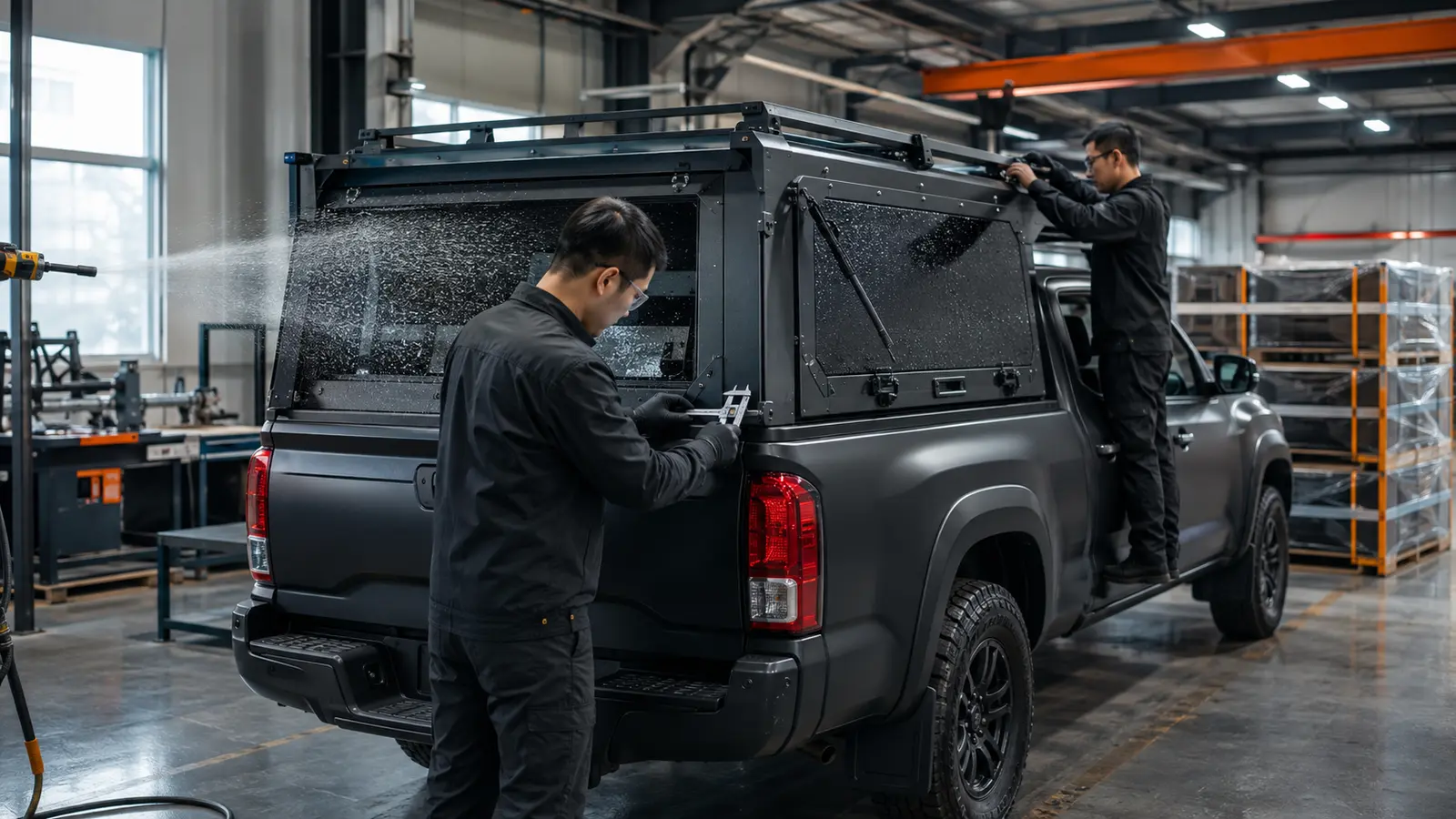
Manufacturers should perform practical spray testing on a fully assembled canopy. The test should cover the roof, doors, corners, windows, mounting points, and the connection between the canopy and truck bed.
Buyers should also distinguish between water resistance and complete waterproofing. A canopy designed for normal rain exposure may not be intended for high-pressure washing or water immersion.
3. Vehicle Fitment and Dimensional Accuracy
Even a structurally strong canopy can become difficult to install if its dimensions do not match the pickup bed accurately.
Professional manufacturers normally develop vehicle-specific canopies using 3D scanning, original vehicle measurements, CAD modeling, or verified OEM dimensional data. These methods help control the curvature, bed-rail geometry, tailgate clearance, and mounting positions.
Important fitment points include:
- Truck bed length and width
- Bed-rail shape and curvature
- Cab-to-canopy clearance
- Tailgate opening clearance
- Rear window alignment
- Brake light and camera visibility
- Compatibility with bed liners and rail caps
- Clamp positions and installation access
Where the truck structure permits, a no-drill mounting system using original mounting points or dedicated C-clamps can simplify installation and reduce permanent vehicle modification.
For a vehicle-specific application, buyers can review the Ford Maverick Canopy 2022 OC10189 and compare how the canopy is developed for a particular pickup model rather than as a universal enclosure.
Before mass production, the supplier should complete a trial installation on the actual vehicle or an accurately verified vehicle fixture. A first-article inspection report should record critical dimensions and confirm that doors, latches, seals, and mounting hardware operate correctly.
4. Structural Strength and Load Testing
Canopy load capacity should never be evaluated from material thickness alone.
Panel design, frame geometry, welding quality, fastener locations, roof reinforcement, and load distribution all affect structural performance.
Manufacturers should clearly distinguish between two types of load ratings:
Static Load
Static load refers to the weight the canopy can support when the vehicle is stationary. This may include a parked rooftop tent, camping equipment, or people using the tent.
Dynamic Load
Dynamic load refers to the weight the canopy can safely support while the vehicle is moving. It is usually lower than the static rating because acceleration, braking, vibration, cornering, and uneven roads generate additional forces.
If a supplier claims a static load capacity of 300–400 kg or more, buyers should ask:
- Is the load evenly distributed or concentrated?
- Does the rating apply to the roof or the complete canopy?
- What roof rack or crossbar system was used?
- Was the test performed on-road or off-road?
- What safety factor was applied?
- Is a test report available?
Useful structural validation may include:
- Static proof-load testing
- Dynamic road testing
- Vibration testing
- Roof-rack load simulation
- Hinge cycle testing
- Door and latch durability testing
- Fastener pull-out testing
- Weld inspection
A trustworthy manufacturer should define the test conditions instead of providing only a maximum load number.
5. CKD/SKD Design and Export Packaging
For international buyers, product quality also includes the condition in which the canopy arrives.
Fully assembled canopies occupy considerable container space and may increase freight costs. CKD or SKD packaging can reduce shipping volume, but only when the product has been designed for efficient assembly.
A good knock-down canopy system should include:
- Clearly numbered components
- Pre-positioned mounting holes
- Standardized fasteners
- Assembly drawings or videos
- Specified tightening torque
- Replaceable sealing materials
- Installation tools or a tool list
- Final quality-control records
Packaging should protect painted surfaces, glass, windows, corners, hinges, and hardware throughout loading, sea freight, unloading, and inland transportation.
Common protective measures include:
- EPE foam or pearl cotton
- Reinforced corner protectors
- Separate hardware boxes
- Anti-scratch films
- Moisture protection and desiccants
- Strong export cartons or wooden frames
- Internal dividers that prevent component movement
Buyers should request the package dimensions, gross weight, container-loading quantity, and assembly procedure before confirming an order. A trial shipment or packaging test can help identify potential damage risks before mass delivery.
A Practical Supplier Audit Checklist
Before choosing a pickup truck canopy manufacturer, request the following documents and evidence:
- Material specifications and certificates
- Surface-treatment process description
- Coating thickness and adhesion records
- Salt spray test report
- 3D scanning or CAD development records
- Vehicle trial-fitment photos or reports
- Water spray test results
- Static and dynamic load test conditions
- Door, hinge, and latch cycle test records
- CKD/SKD packing drawings
- Assembly manual
- Quality-control and product traceability procedure
A supplier that can provide clear technical evidence is generally more reliable than one that offers only product photographs and verbal claims.
Conclusion
Evaluating a pickup truck canopy manufacturer requires a complete review of corrosion protection, sealing design, dimensional accuracy, structural validation, and export packaging.
Price remains important, but the lowest initial quotation may result in higher costs if the products develop rust, leak during rain, fail to fit the vehicle, or arrive damaged.
The best approach is to inspect the factory’s production process, evaluate a sample on the actual vehicle, and verify every important performance claim with documented testing. This helps importers, distributors, and vehicle-accessory brands reduce after-sales problems and build a more reliable long-term product range.