A customer texts your shop, “I have a 2024 F-150 and need a bed cover. What will it cost?” Your counter staff can get the job moving with one reply. Ask what the customer wants to carry, whether they want a flat tonneau or an enclosed truck cap, and for a photo of the tape stretched along the bed floor with the tailgate closed. The answer identifies what to price. The photo gives your installer something to check before parts are ordered.
Use the short form below for the first call. A straightforward tonneau inquiry should take only a handful of fields. Add the opening, cargo and overall-height measurements when a customer needs a canopy for tools or equipment. Keep the customer’s readings, the vehicle manufacturer’s specifications and the supplier’s approved drawing in separate places on the work order. Each answers a different question.
Send this measurement request with the first reply
Copy the following into a text or email. A shop buying for a fleet can send it to the person who has the truck and have them put the unit number in the subject line.
Truck and job: Year ___ / make ___ / model ___ / cab style ___ / truck or fleet unit ID ___.
What would you like fitted? Flat tonneau / enclosed cap. What equipment or cargo does it need to cover? ___.
Bed length: Front inside wall to the inside of the closed tailgate, straight along the bed floor ___ inches. Is there a thick liner, mat or insert at either end? ___.
What needs to stay on the truck? Bedliner, factory track, tie-downs, toolbox, existing cover hardware or other fittings ___.
For a cap, if your shop has supplied a sketch: Width between the marked front rail points ___ / between the marked rear points ___ / units ___. Add photos of the tape at those points.
Photos: One overall view from the rear, one showing where the tape starts, one showing the reading and end point, and a clear view of the top and inside edge of each bed rail.
For a trade quote: Shop name ___ / contact ___ / quantity by truck configuration ___ / delivery ZIP code ___.
Give the customer a way to answer “unknown.” A photo of an unfamiliar track is more useful than a guess about its brand. If an existing cover hides a mounting surface, have the customer photograph what is visible. Your installer can inspect the concealed part at the shop. There is no reason to ask a customer to remove hardware just to get a price range.
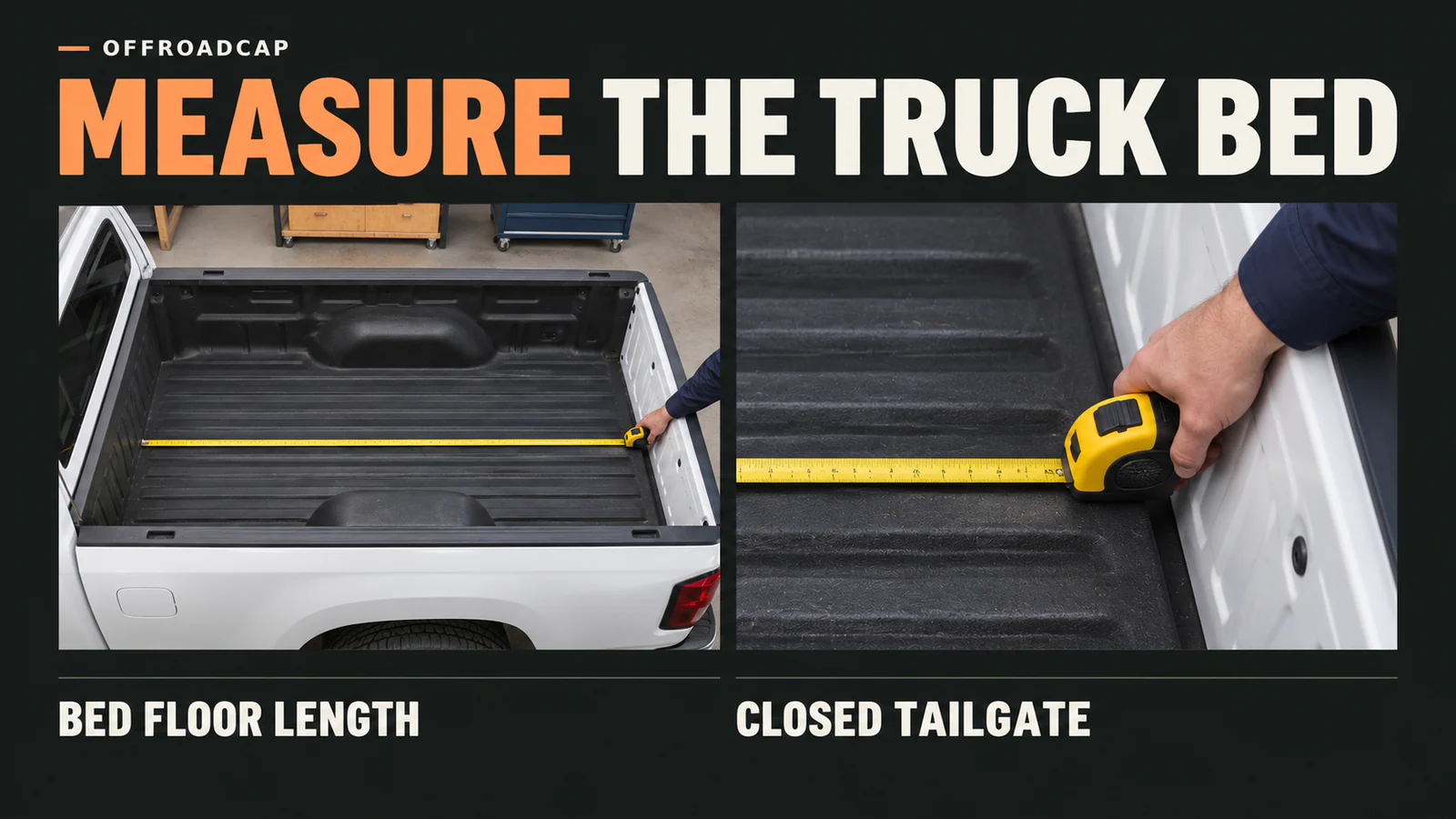
How to measure truck bed length with the tailgate closed
Ask the customer to clear one straight path from front to back and latch the tailgate. Rest the end of the tape against the inside face of the front bed wall at floor level. Run the tape parallel to the side rail, then read it where it meets the inside face of the closed tailgate at the same height. Position the tape clear of a wheelhouse or loose cargo so it stays straight. A measuring partner can hold the front end while the customer photographs the rear reading.
Record inches as actually read. A nominal size such as “six and a half feet” belongs in a separate field. If the tape reaches a molded liner instead of the original bed wall, identify that surface in the photo. A raised mat can move the reading up onto an angled part of the front wall or tailgate. If that is the only accessible point, write down where it was taken so your installer can reproduce it.
Check the two photos before matching a product. Can you see the end of the tape touching the front wall? Is the tailgate upright in the shot with the reading? A tape hooked over the outside edge of the tailgate can look convincing in a close-up. If either end is unclear, request that one view again. Asking for a specific photo is easier on the customer than asking them to measure the whole truck twice.
Use the floor length to select a catalog entry
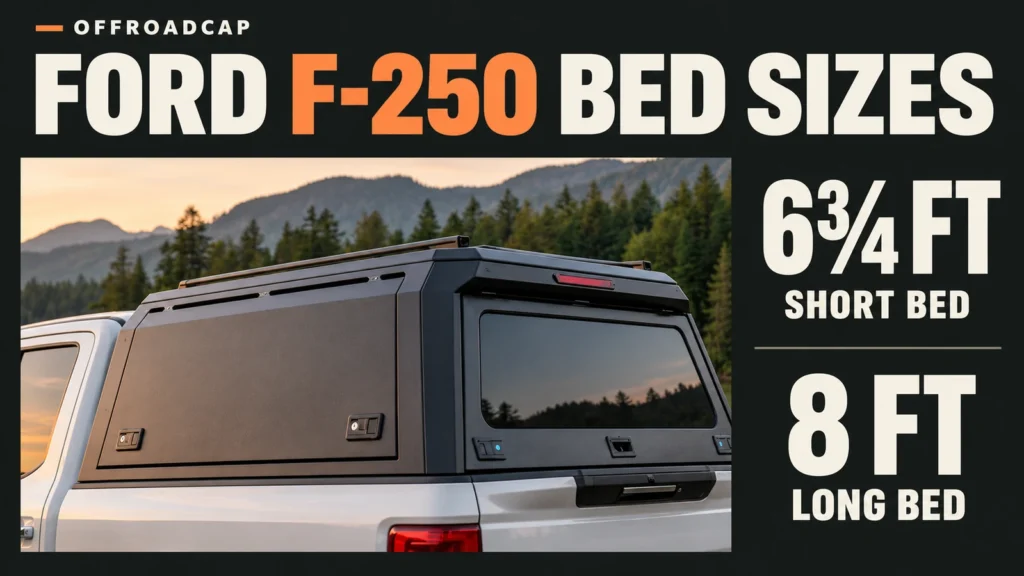
Ford’s U.S. specifications for the 2024 F-150 illustrate why an exact field reading matters. Ford lists three Styleside box lengths. The table pairs Ford’s inside-floor dimensions with the corresponding nominal sizes in OFFROADCAP’s F-150 canopy catalog. The part numbers give your buyer a starting point for a fitment inquiry.
| 2024 F-150 Styleside box | Ford inside length at floor | OFFROADCAP canopy listing to check |
|---|---|---|
| 5.5 ft | 67.1 in | OC20109, Ford F-150 5.5FT |
| 6.5 ft | 78.9 in | OC20134, Ford F-150 6.5FT |
| 8.0 ft | 97.6 in | OC20209, Ford F-150 8FT |
The source is the cargo capacities table in Ford’s 2024 F-150 technical specifications. Ford also lists the same 50.6-inch width between the wheelhouses for all three boxes. A customer who sends only that width has supplied a useful cargo dimension, but you still need the floor length to distinguish these applications.
Write the make and model beside every part number. OFFROADCAP also lists a 5.5FT Toyota Tundra canopy, OC20146. A quote that says only “5.5-foot cap” leaves purchasing to choose between different truck applications. Before releasing the order, match the exact model year, cab, bed and rail equipment to the supplier’s current application record.
Check the surfaces the selected product actually uses
Measuring a truck bed for a tonneau cover
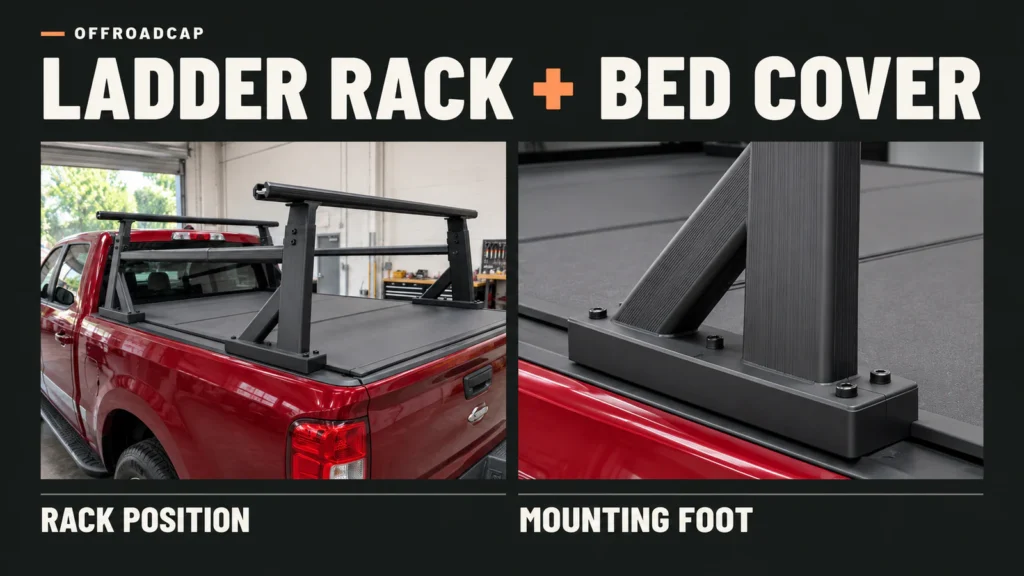
Pull the fitting instructions for the candidate model. If the cover maker specifies a length at rail height, take that reading separately and label its endpoints. Use that figure for the cover maker’s fit chart and keep the floor reading on the vehicle record. Identify where the side rails sit and where each clamp or fastener needs access. Ask for an underside photo only at a position the instructions identify. An over-the-rail liner can hide the edge in that photo. Note whether it covers the top, the inside face or both. The shop can then ask the supplier about the liner and fitting kit in a single message.
Checking the truck cap base and tailgate
For an enclosed cap, request the drawing that shows where the base lands on the front and side rails and where the rear door meets the tailgate. To record upper width, choose the edge shown on the drawing and use the same edge on both sides. Measure at the indicated front station, then at the rear station. Label them separately. If the drawing calls for a diagonal, mark its two endpoints on a photo before sending the reading. An unexplained “bed width” gives purchasing too little to work with.
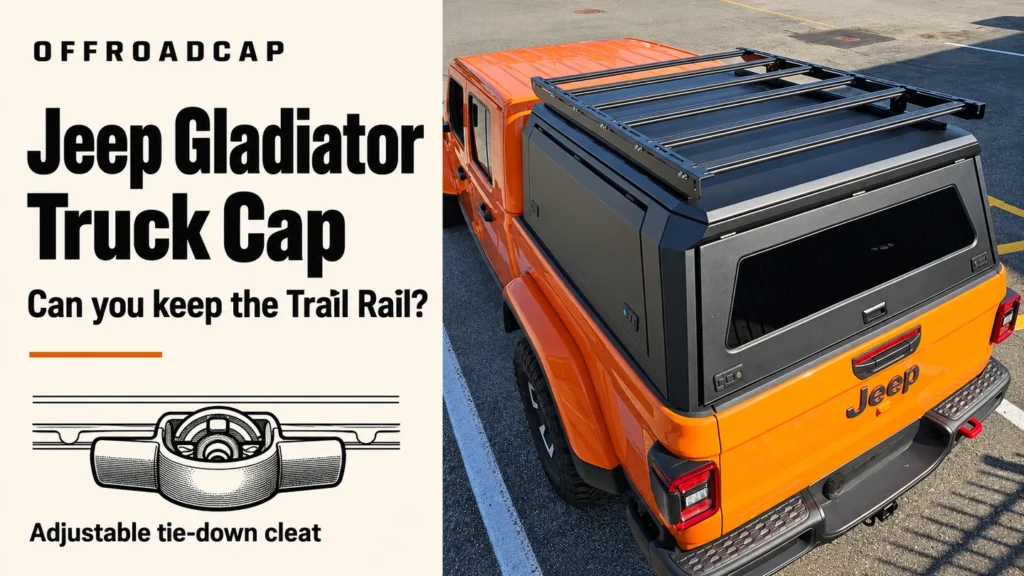
If the truck is used or already upfitted, look at both rear corners. A toolbox bracket, bed-slide stop or patched rail can affect one side only. Include the accessory label and show whether the customer needs to retain it. Your buyer can then request an approved hardware option, or quote a shop inspection where the mounting surface is hidden. For clamp-specific questions, refer the installer to the canopy mounting and clamp guide and the instructions for the selected kit.
Truck cap dimensions to check when loading tools through the rear door
Once the canopy application is identified, ask the customer to identify the largest item they load regularly. Have them measure it as carried, including handles, feet, casters or a cart. Record which end goes through the door first and whether the operator needs room above or beside it for their hands. A hard case that slides in from the rear may need to come out through a side door at a jobsite. Put that second movement on the order if it matters to the customer.
Start with an assembled drawing showing the clear opening between the frame, seals and projecting hardware. Next, follow the item to its storage position. Mark any shelf lip, wheelhouse or drawer front it must pass. A cardboard outline of the item’s end face can help check the doorway on a demonstration unit. If the item has to turn inside, use the actual item or a full-size mock-up that includes its depth. A flat template cannot demonstrate that turn.
Ask about the building as well as the truck. A fleet may need its vehicle to pass under a garage door with roof equipment in place, or to open a side door in a narrow service bay. Record the lowest obstruction along the actual entry route and the space available where the driver unloads. Verify finished vehicle height with the specified tires, suspension and fitted roof equipment before promising garage access. Agree usable clearance with the customer and the site operator.
Turn the readings into a price the customer can approve
Separate the price of the requested equipment from the work needed to fit it. An initial estimate can name a candidate model and list the open issue beside it, such as “please confirm the factory track shown on the passenger side.” This lets the customer compare configurations while giving the next person at the desk a precise follow-up. Once the supplier confirms the part number and fitting kit for the truck shown, add that written reference to the order.
Keep freight figures on a separate line. For the 6.5FT F-150 canopy OC20134, OFFROADCAP lists a main carton of 211 × 46 × 66 cm and a roof carton of 137 × 108 × 13 cm. Those numbers are useful to the receiving team. Neither carton tells the installer how wide the finished rear opening is. Request the assembled drawing for the customer’s equipment check and the final packing list for the freight quote.
Use one of these notes to hand the job from sales to purchasing:
- Ready to price. Record the vehicle configuration, candidate product, quantity and remaining assumption. Name the person who will verify it and leave installation timing open until the outstanding fitment question is answered.
- One detail needed. Ask for the missing reading or photo by name and explain what decision it affects. “Please photograph the inside rail below the toolbox bracket so we can identify the fitting kit” is a request a customer can act on.
- Ready to order. Attach the supplier’s application confirmation, hardware list, approved scope and any accessory removals the customer has authorized. Include the drawing reference if opening size, door travel or installed height is part of the sale.
For repeat builds, keep one approved record per configuration
Ask the fleet buyer for quantities against each model year, cab, bed and rail arrangement. Two trucks with the same badge may arrive with different liners or storage equipment. The installer should be able to open a unit record and see which accessories stay, the agreed loading route and the exact hardware pack. Reuse the field sheet when another truck arrives. Check its photos against the approved configuration before repeating the order.
For a mixed fleet, send the appropriate follow-up with each truck record. Use the F-150 fitment guide for the Ford group. For a Ram 2500 recorded as a 6.4-foot box, give the buyer the OC20203 application listing to check against that truck’s rail photos. This keeps the buyer from applying one vehicle’s confirmation to another line of the same purchase order.
Where the customer is ordering several caps to the same specification, agree with the supplier which measurements will be checked on the first fitted unit. Record the drawing revision, how those measurements are taken and the acceptance criteria agreed for that job. Test the customer’s representative equipment with the quoted shelves or boxes installed. If a drawer position or door fitting changes during that review, update the drawing reference and the shop order before the next truck enters the bay.
Need a model and fitting-kit check for a customer quote? Paste the truck measurements and quantity per configuration into the project details field. Email the rail and tailgate photos to the regional sales contact listed on the same page, using your shop name and truck ID in the subject line. Include the clear opening your customer needs if the order depends on loading a specific piece of equipment. Ask for the applicable canopy or cover reference, mounting details and packing information for delivery to your shop. Request a trade fitment review and quote.