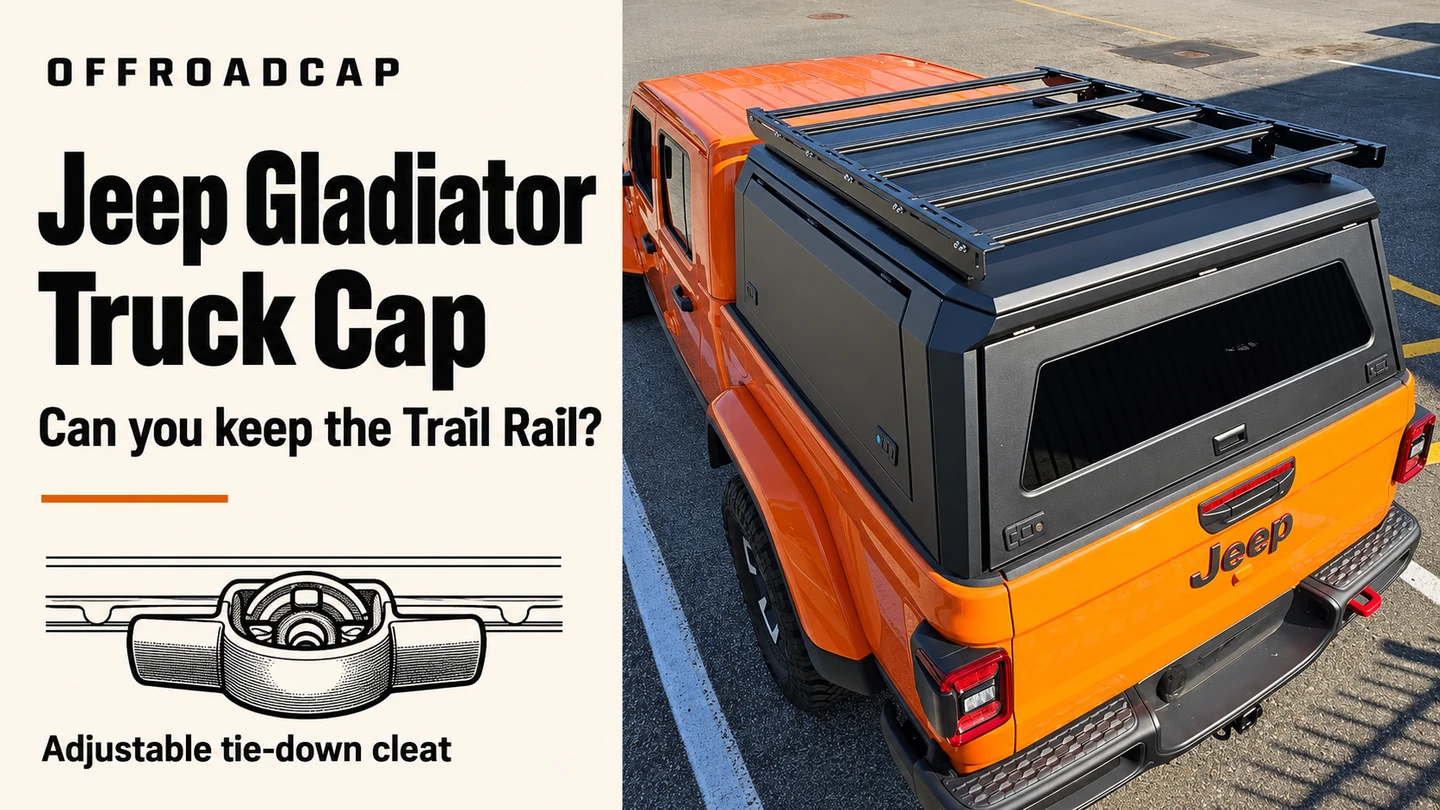
Can your customer keep the factory Trail Rail when you fit a Jeep Gladiator truck cap? OFFROADCAP lists its aluminum OC10139 for the Gladiator JT with a 5-foot bed. The public specification identifies the cap and its available styles. Confirming that the customer can still reach, move and remove a tie-down cleat takes another piece of information: where the mounting hardware for the selected cap sits in relation to that truck’s rails.
Start the quote with two entries on the job card. Put the cap style and vehicle application on the first. On the second, write down the rail functions the customer wants to keep. A customer who leaves a cleat in one position has a different acceptance requirement from one who removes it to change accessories. That distinction gives your salesperson a specific question to send to the factory and your installer a specific check to demonstrate at handover.
1. Record how the customer uses the rails
Ask the person who loads the truck to show you the tie-down points they use. Have them mark those positions with removable tape beside the track. If they change positions between loads, ask them to mark the full range they use. Record which cleat moves, where it starts, where it stops and whether they ever take it out. For a remote inquiry, a short phone video of the movement gives the installer information a single photograph cannot show.
Give each vehicle its own entry. Record the fleet unit number, model year, bed length, liner type, and any tonneau brackets or rack feet still fitted. For an accessory the customer wants removed, record who will remove it and whether the parts must go back to the fleet. Old cover hardware left below the bed lip can be hard to see in an exterior photo, yet it changes the work your technician will have to do.
Message to send the fleet manager
“Please label the photos with the vehicle’s unit number or registration reference. Include a view into the open bed, a close-up of each side rail and the front corners behind the cab. Mark the tie-down positions your crew uses and tell us whether a cleat needs to come out. Identify any cover or rack hardware you want to keep.”
2. Build a photo set the factory can measure against
Mopar lists the Gladiator Trail Rail system as part 82215956. It has rails on both sides of the bed and across the front wall. That number identifies the cargo accessory in the photos. The mounting kit for the cap needs its own reference on the quote. Ask for these four views with left and right identified from the driver’s seat. Mopar Gladiator accessory catalog
| View | What to include in the frame | Decision it supports |
|---|---|---|
| From the open tailgate | Both bed sides, the front wall and the positions marked by the driver. | Which track and which cleat does the driver need to use? |
| Along each side rail | The bed lip, track face, cleat retainer and liner edge in the same shot. | Can the installer identify the mounting surface and the space needed to reach the retainer? |
| At the cab end | Both front corners and the left end of the front rail. Include any accessory beside an opening. | Could the proposed hardware interrupt the cleat’s route to its removal point? |
| At existing hardware | Each old cover bracket or rack foot, its attachment point and the area immediately around it. | Which items need a removal allowance or a separate fitment review? |
If the factory requests a dimension, agree on a reference point. For a side-rail position, put the zero end of the tape at the cab end of that rail and measure to the center of the marked detent. Show the tape origin in one photo and the reading in another. Label the unit of measure. A liner may conceal the edge the factory needs to see. In that case, mark the photo “edge concealed” and arrange a shop inspection before committing to labor.
3. Put OC10139 and the mounting kit on separate quote lines
The OC10139 specification covers the 2020 and newer Gladiator JT, 5.0-foot bed. It lists Base, Plus, Pro and Pro Max. Ask which style the buyer wants priced and which options to include in the quoted configuration. The product page does not show bracket locations for each style. If the customer switches style after receiving the estimate, send the revised configuration to the factory before carrying over the rail-access commitment. OFFROADCAP OC10139 product specifications
Keep the weight figures straight when purchasing and workshop staff share the quote. The catalog lists 59.86 kg total net (about 132 lb) and 71.74 kg total gross under its published packing specification. Purchasing can use the gross figure for a preliminary freight estimate. If the fleet tracks installed accessory weight, ask for the figure for the chosen cap, kit and options. Enter that confirmed value on the vehicle build sheet.
For the mounting-kit line, ask for a part or kit reference, the applicable fitting instructions, and a marked view of where its brackets attach on this bed. Supply the truck photos alongside the request. A reply that only confirms “fits a Gladiator” resolves the vehicle application. The remaining question is whether the driver can use the marked positions with the quoted kit in place.
Factory inquiry to copy and complete
“Please quote OC10139 in [style] for a [model year and market] Jeep Gladiator JT with a 5-foot bed. Liner and existing hardware: [details]. The attached photos show the rail functions we need to retain: [positions, travel and removal, as applicable]. Please identify the fitting kit, mark its attachment points and confirm access at each marked location. Please itemize the cap, mounting kit, options and freight for [quantity] to [destination].”
4. Resolve the bracket that looks clear in a photo
Compare the marked truck photos with the mounting arrangement supplied for the selected cap. Start at a cleat the driver actually uses. Look at the space around the retainer, then follow the length of track the cleat needs to travel. Check both the path and the destination. A photo of a cleat sitting clear of a bracket can show its resting position while leaving open whether it can reach the next position or whether the driver can operate the retainer by hand.
The 2024 Jeep manual identifies two adjustable cleats on each side. The side-rail exit is toward the cab, while the front rail has a separate exit at its left end. Have the supplier mark the relevant opening on the photo and compare it with the proposed bracket footprint. A top-down photo can show an apparent overlap between parts at different heights. If the side view cannot resolve it, have the installer check it on the customer’s truck under the approved fitting instructions. 2024 Jeep Gladiator Owner’s Manual, “Bed Rail Tie Down System”
For any disputed location, mark the cleat and the bracket on the same view and send that image to the factory. Ask which movement the layout allows and where any restriction would occur. Keep the answer with the quote. If a function the buyer requires remains unconfirmed, list it as an open fitment item and identify who will check it. Where a different bracket location is proposed, ask for the manufacturer’s instructions for that arrangement before including it in the job.
5. Give purchasing an itemized quote it can act on
A distributor may supply only the cap and hardware. An installation shop may also remove an old cover, arrange delivery and demonstrate the tie-downs to the driver. Put those responsibilities on the estimate before the purchase order is issued. The following fields let purchasing compare the supplier’s offer with the work the customer actually requested.
| Quote line | What to enter | What supports that entry |
|---|---|---|
| Cap and options | OC10139, selected style, finish and accessories requested by the buyer. | The current supplier quotation identifying what is included in that configuration. |
| Mounting hardware | Fitting-kit reference, supplied components and any hardware ordered separately. | The manufacturer’s reply for the photographed rail and liner combination. |
| Existing equipment | Items to retain, remove or return, and the party responsible for the work. | The buyer’s marked photos and agreement on the scope of removal. |
| Delivery | Ship-to address, packaging basis and freight from the supplier or forwarder. | The packing details for the actual order and destination. |
| Installation and handover | The shop’s price for the agreed work and the rail functions included in the demonstration. | The installer’s review of the fitting instructions and vehicle. Identify any item awaiting inspection. |
A molded liner may cover the bed edge the installer needs to inspect. An old tonneau bracket may hide an attachment surface. If the photos leave either point open, the dealer can still quote the selected cap and confirmed options. Label the affected kit or installation line “pending vehicle inspection,” then tell the buyer what will settle it. A blank price or a zero can look like an item included at no charge when purchasing transfers the estimate into its order system.
Before accepting the order, compare the customer’s purchase order with the quotation. Check the style as well as the part number, who supplies the fitting kit and which existing accessories the customer expects back. Copy any unresolved condition onto the order acknowledgment. This keeps the customer’s request to retain a rail accessory visible to the technician who receives the job.
6. Check the delivered kit against the approved configuration
Give the installer the latest fitting instructions, the accepted quote and the marked rail photos together. At receiving, match the cap and style to the order paperwork. Check the hardware supplied against the kit list for that order, including components packed separately. Record the reference from the packaging or dispatch paperwork. If a bracket looks different from the one in the approved drawing, photograph it beside its label and ask the supplier to identify it before fitting.
Look inside the actual bed again when the truck arrives. Compare the liner edge, rail ends and existing brackets with the photographs submitted for review. Mark on the work order any accessory fitted since the quote was prepared. If a cover is to be removed and returned, identify the pieces belonging to it and agree where they will be handed back. That gives the driver and the shop a shared record of what came off the truck.
For a vehicle that differs from the approved photos, send only the information needed to resolve the difference. Identify the exact corner or rail, include one wide view for orientation, and attach the close-up with the kit reference. Ask whether the prescribed arrangement still applies. Record the response against that vehicle so another technician can pick up the job without starting the fitment inquiry again.
7. Record the result on the truck at handover
Use the customer’s marked photographs during the demonstration. With the bed empty and the cap fitted according to its instructions, ask the installer to show the agreed movements. The table below can go directly onto a work order. Fill in the observations on the vehicle and identify the side or specific cleat for each entry.
| Function to demonstrate | Observation to enter at handover |
|---|---|
| Reach and seating | Marked position, access to the retainer and whether the cleat seats at the requested detent. |
| Travel between working positions | Start and end marks actually reached, with the location of any obstruction. |
| Cleat removal, if requested | Rail and exit used, whether the cleat can be taken out and refitted, and any restriction observed. |
| Accessories and exceptions | Items retained or returned, open issue, photo reference and agreed follow-up. |
Add the cap style, kit reference, instruction revision where available, date and installer to the completed sheet. If a required movement is blocked, photograph the cleat at the point where it stops. Send the photo and kit reference to the factory for review, and record the outcome after any approved correction. For a repeat Jeep Gladiator cap order, compare the next vehicle’s actual rails, liner and existing hardware with that signed-off record before carrying its fitment details forward.
For a Gladiator bed cap quote from OFFROADCAP, send your model years, fleet quantities, destination, preferred OC10139 style and photos of the rails and liner. Mark one load change your customer must keep. We can review the fitting-kit requirements with your installer before you price the batch. Send your Gladiator photos and request a dealer quote.