
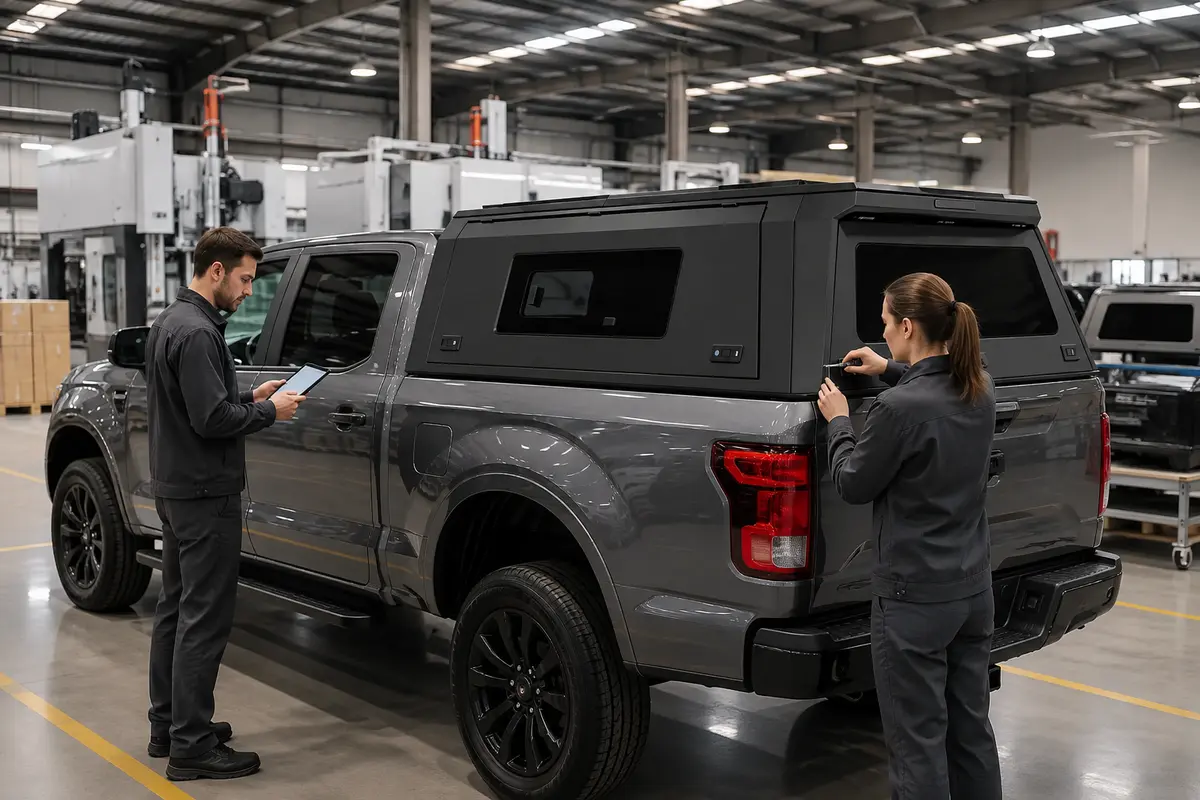
Choosing the right OEM truck cap supplier involves much more than comparing unit prices. For distributors, vehicle accessory brands, fleet operators, and aftermarket businesses, the quality of the supplier directly affects product fitment, durability, delivery reliability, and long-term customer satisfaction.
Before placing an OEM or ODM order, global buyers should evaluate the complete supply process—from vehicle data and engineering capabilities to manufacturing, inspection, packaging, and after-sales support.
1. Define Your Product and Market Requirements
A reliable project begins with a clear product specification. Buyers should identify the intended vehicle brands, model years, bed sizes, target markets, and main applications.
Important requirements may include:
- Compatible pickup truck models and production years
- Truck bed dimensions
- Side window or side-door configurations
- Roof rack and accessory requirements
- Payload and working conditions
- Surface finish and color
- Locking and security requirements
- Branding and packaging requirements
A truck cap designed for commercial fleets may need different storage and security features from one intended for camping or overlanding.
Buyers can explore our Pickup Canopy Series to understand the available product configurations.
2. Evaluate Vehicle Fitment Capabilities
Fitment is one of the most important factors in a truck cap project. Even a small dimensional difference can affect installation, sealing, appearance, and long-term performance.
An experienced OEM truck cap supplier should be able to work with:
- Vehicle measurement data
- 3D scanning information
- CAD drawings
- Prototype fitment tests
- Different bed lengths and vehicle variants
- Model-year updates
Before mass production, buyers should confirm the exact vehicle model, manufacturing year, cab configuration, and truck bed dimensions.
3. Review Materials and Structural Design
Truck caps are exposed to rain, sunlight, dust, vibration, road salt, and changing temperatures. Material selection and structural engineering therefore have a direct impact on product life.
For aluminum truck caps, buyers should evaluate:
- Aluminum grade and thickness
- Frame and panel construction
- Welding consistency
- Reinforcement at load-bearing areas
- Door and window structure
- Hinges, locks, and gas struts
- Weather seals
- Powder-coating quality
- Corrosion protection
A lightweight structure is valuable, but it should not compromise strength, security, or durability.
4. Confirm Customization Options
OEM and ODM buyers often require more than a standard product. Customization allows distributors and vehicle accessory brands to create products that match their market positioning.
Common customization options include:
- Product dimensions
- Side-door configurations
- Sliding or pop-up windows
- Roof racks and crossbars
- MOLLE panels
- Storage boxes
- Interior LED lighting
- Central locking systems
- Surface colors and finishes
- Logo plates and private-label branding
- Retail or export packaging
Our Accessories Series can also be combined with pickup canopies to create application-specific solutions.
5. Understand the Quality-Control Process
Global buyers should ask how product quality is controlled throughout production—not only during final inspection.
A complete quality-control process may cover:
- Incoming material inspection
- Dimensional and fitment verification
- CNC cutting accuracy
- Welding inspection
- Surface-treatment inspection
- Door, lock, and window testing
- Water-resistance and sealing checks
- Final assembly inspection
- Packaging inspection
Buyers should also confirm how defects are documented and handled before shipment.
6. Check Production Capacity and Lead Time
Production capacity should match the buyer’s order volume and delivery plan. A supplier may be capable of producing excellent samples but still struggle with stable batch production.
Before confirming an order, discuss:
- Sample development time
- Minimum order quantity
- Monthly production capacity
- Mass-production lead time
- Peak-season scheduling
- Replacement-parts availability
- Order-change procedures
For new projects, beginning with a prototype or controlled trial order can help verify product quality and market response.
7. Review Packaging and Global Shipping
Truck caps are large products that require carefully designed export packaging. Inadequate protection can cause scratches, deformation, broken windows, or damaged hardware during transportation.
Buyers should confirm:
- Individual product protection
- Reinforced export cartons or crates
- Protection for windows, corners, and coated surfaces
- Hardware and installation-kit packaging
- Product labels and carton marks
- Container-loading plans
- Shipping documentation
Efficient packaging can reduce freight damage while improving container utilization.
8. Evaluate Communication and After-Sales Support
OEM projects usually involve technical confirmations, drawings, samples, production updates, and logistics coordination. Clear communication is therefore just as important as manufacturing equipment.
A dependable supplier should provide:
- Timely project updates
- Clear technical documentation
- Installation instructions
- Spare-parts support
- Response procedures for quality issues
- Long-term product and fitment support
The goal is not simply to complete one order, but to establish a stable supply relationship that supports future product development.
OEM Truck Cap Supplier Checklist
Before selecting an OEM truck cap supplier, confirm the following:
- Does the supplier understand your target vehicle models?
- Can it provide engineering and fitment support?
- Are materials and finishes clearly specified?
- Can accessories and branding be customized?
- Is the quality-control process documented?
- Can production capacity meet your delivery schedule?
- Is export packaging suitable for international transportation?
- Are spare parts and after-sales support available?
Build Your OEM Truck Cap Project with OFFROADCAP
OFFROADCAP provides aluminum pickup canopies and related accessories for distributors, vehicle brands, fleet customers, and aftermarket partners. Our team supports product development, customization, manufacturing, quality inspection, and international delivery.
If you are planning a new truck cap project or looking for a long-term OEM and ODM manufacturing partner, contact OFFROADCAP to discuss your vehicle models, specifications, order requirements, and target market.